The Naming of Indiana
Many people know that the name “Indiana” means “Land of the Indians.” Fewer are aware of the conditions immediately prior to the official adoption of that term and the dark story surrounding it, and fewer still are prepared to undertake the changes needed to live up to that name. This is that story, told briefly.
The Illegal Settlement Period
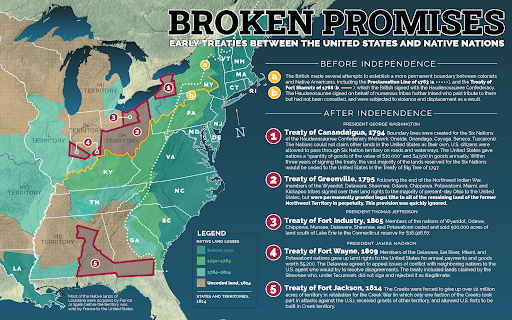
To understand Indiana’s name, we must first examine the period before American independence. Before even the birth of the United States as an independent nation, waves of white settler colonists from the eastern seaboard made the trek over the Appalachian Mountains into the Ohio River Valley, settling on inhabited Native-owned lands, mainly in what is now called Kentucky, Ohio, and Indiana.
These settlers, led by people like Daniel Boone, were both breaking the law and (more importantly) occupying land legally reserved for Native Americans, violently displacing large numbers of them in the process. Royal proclamations and treaties signed between the British and Native Americans prior to Independence had attempted to establish a more permanent border between the coastal colonies and the interior tribes. While the details changed several times over the period, White settlement to the west of the Appalachian Mountains had been largely banned.
Colonial thirst for Native land was unquenchable, however, and thousands of settlers crossed the mountains into Native territory anyway, occupying land that was not theirs to take and violently displacing Native Americans in the process. This insatiable desire to steal more Native land for White settlement was one of the main drivers of the movement for independence. Many of the Founding Fathers had invested their personal fortunes in land speculation in these areas, and thus directly profited from the displacement of Native peoples that resulted from the independence movement they led and promoted through colonial newspapers and pamphlets. Most Native American groups sided with the British during the War for Independence with good reason, because they wisely saw the onslaught that was coming if the Americans were taken off the leash.
The Northwest Indian War
These waves of White settlers into Native land inevitably led to violence between Native peoples defending their lands and the waves of armed White settlers flowing over the mountains. At the end of the War for Independence, the British were forced to cede all of the land of the present-day Midwest to the new United States.
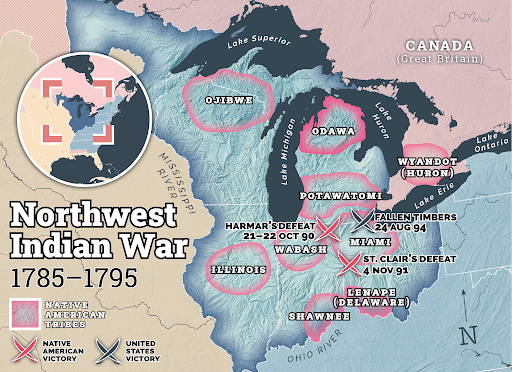
The Native groups living there were not consulted, and obviously did not agree to these ridiculous terms. So, almost immediately after independence, the United States faced a united confederacy of Native American groups in the Northwest Territory, concentrated in what we now call Indiana and Ohio. The very first war the United States fought was against Native Americans defending their territory from American settlers.
The loose multi-ethnic and multi-lingual Native American confederacy that formed, led by the Shawnee leader Blue Jacket and Miami Little Turtle, among many others, represented one of several attempts by indigenous groups to teach the United States and the colonies that preceded it an important lesson through their resistance, one that we still have not learned today: “Enough.”
Initially, this war went very poorly for the Americans. They lost several major battles, including St. Clair’s Defeat in 1791 (named after the American commander General Arthur St. Clair, whose name we will hear again), where American casualties were greater than 97% (632 out of 920 soldiers were killed, with an additional 264 wounded) against Native forces under the leadership of Blue Jacket, Little Turtle, and Buckongahelas. St. Clair’s Defeat is to this very day the most decisive battle loss in U.S. military history, and the greatest victory Native Americans ever achieved against U.S. forces in any war. The Americans went through several military commanders as the Native confederacy continued to win.
Faced with this successful Native American resistance movement, the U.S. needed a new strategy. Unfortunately, one was found in General “Mad” Anthony Wayne, who spearheaded a scorched-earth strategy of targeting food supplies, shelter, and civilian “soft” targets. This brutal approach of ethnic cleansing and genocide developed in the Ohio Valley would serve as the model for all subsequent U.S. Indian wars to follow. And more than a century later, these same scorched-earth strategies and the legal framework that developed around them during America’s westward expansion, which started right here in Indiana and Ohio during the Northwest Indian War, would be carefully studied by Nazi Germany as they planned their own campaigns of racial discrimination and territorial expansion in Europe.
The Broken Promise of “Indiana”
Wayne’s strategy of targeting food supplies prior to winter, and other civilian soft targets, eventually led to the defeat of the Native American confederacy at the Battle of Fallen Timbers in northwestern Ohio in 1794. The Native tribes were forced to sign the Treaty of Greenville in 1795, ceding the majority of present-day Ohio.
As a condition of signing that treaty, however, the Natives were promised something critically important: The remainder of the Old Northwest was to be permanently granted to the Native Americans in perpetuity. This included all or most of the present-day states of Indiana, Illinois, Michigan, and Wisconsin, and smaller parts of Minnesota. This is where the name “Indiana” was born. This was supposed to be the permanent Land of the Indians. While the name had been tossed around informally prior to this, it was only after this point that the name was used in any official capacity by Congress, being used in 1800 to name the Indiana Territory, which was composed of most of the rest of the land outside of that ceded in the Treaty of Greenville.
The Aftermath
Within 10 years, another Native American confederacy would form (led by Blue Jacket’s spiritual successor, the Shawnee leader Tecumseh and his brother Tenskwatawa), and another war would break out after the promise of perpetuity was repeatedly ignored by the Americans. Rather than Indiana becoming a permanent home for Native Americans as was promised, multiple places are now named after the very people who took this land from them. Fort Wayne, our second largest city, is named after — guess who — “Mad” Anthony Wayne, the architect of the U.S.’s scorched-earth tactics against Native Americans, as is Wayne County in east-Central Indiana. St. Clair Street, which goes right by the American Legion Mall in downtown Indianapolis honoring veterans, is ironically named after the military commander who suffered the worst military defeat in U.S. history.
This story is one of several pivotal points in our history where if things had turned out slightly differently, Indiana or other parts of the present-day United States might today be located in an independent Native American nation.
How might we have fundamentally changed had we learned that critical lesson that Native Americans tried to teach us through their resistance so early in our nation’s life? What might it mean to live up to the name “Indiana” today? One way would be to finally, after so many years, learn the lesson of “enough” that Blue Jacket offered. To recognize limits, to not cross them, and to pull back from those that we’ve already crossed. This is, unfortunately, a lesson that we still have not come close to learning today, as can be seen by the pursuit of limitless growth at all costs across all domains. That strategy of unlimited expansion is the same as the cancer cell, and a path of insanity. Native leaders like Blue Jacket and Little Turtle, Pontiac before them and Tecumseh after, and countless others, have all attempted to teach us that. We did not listen then. We must now.
By Zach Ammerman
