Perspectives for January 2026
- From Rev. Susan
- Education Matters
- From the Communications Coordinator
- From the Board of Directors
- From the Name Change Discernment Working Group
- From the Homelessness Task Force
- From the Racial Justice Task Force
- Midwestern Unitarian Universalist Summer Assembly
- A Memorial Garden Memoir and Update
- Upcoming Services
Table of Contents
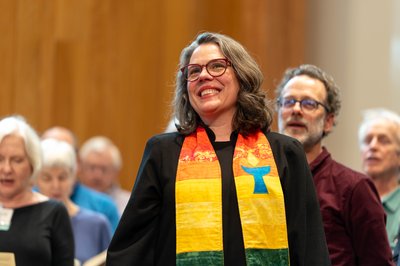
From Rev. Susan
When I called Rev. Bill Breeden to interview him as I was considering the ministry position with UUCB, he told me that this was one of the most courageous congregations he’d ever known - willing to take risks, to show up for what is just, and to do the hard thing when necessary. Courage takes many forms - it can be the strength that helps us resist injustice and organize for democracy, it can be the integrity that helps us hold a position even when we may feel alone, it can be the risk we take when we try something new even when we don’t know how it will turn out, it can be the strength we find when we make hard choices, sometime hard changes, to care for ourselves better. Courage takes many forms.
As 2026 begins, rather than thinking of New Year’s resolutions, I invite us all to reflect on how we might grow our courage in the coming year. Maya Angelou reminds us of the importance of courage because, as she writes, “Courage is the most important of all the virtues, because without courage, you can't practice any other virtue consistently.”
All signs point to 2026 being another year of testing - testing our values, our institutions, and simply our well-being. Let’s be honest, tending to our own well-being will continue to be a priority and challenge. I imagine we all may need a bit more courage to keep showing up faithfully, lovingly, and with a commitment to our own well-being and the well-being of those we love, So, throughout this month of January, we will explore what it means to be a Community of Courage and how we can all grow our courage.
Education Matters
Labyrinth Walk
In the second week of January, we’ll be creating a labyrinth in the Meeting Room. All are invited to come and walk it during office hours (9am - 3pm) from Monday, January 6 to Friday, January 10 – and till 6:30 p.m. on Monday and Wednesday (or later, by appointment).
Leia Durland-Jones writes: “Perhaps one of the most compelling aspects of using the labyrinth as a spiritual practice is that it meets you wherever you are – emotionally, physically, theologically, and spiritually. There is no right way to experience it. You can walk (at whatever pace) or skip, run, dance, crawl, go forward or backward, using the labyrinth in whatever way feels true and right at that time and place. Sitting by or with a labyrinth, either alone or with others, can also be profound. Simply being with the labyrinth form is soothing.”
She goes on to describe one way of experiencing a labyrinth: releasing whatever is on your mind as you enter, being open to receiving insight at the center, and reflecting on that insight as you walk the path out. However, she warns: “I usually have no sense of great revelation magic, or aha moment while on the walk. Expecting this to happen almost ensures that it will not. Yet I have experienced greater understanding of what I carry in my heart and my feelings, as well as increased clarity, a renewed sense of directions, and answers while walking or after a walk.”
Our Whole Lives (OWL) Sexuality Education
OWL classes will be offered starting in February for children in Kindergarten and First Grade, as well as those in Grades 4 and 5. If you have a child in those age ranges, please be sure to fill out this brief survey by January 4, 2026. The survey does not commit your child to participating, but will help us plan by letting us know how many are interested. A parent information meeting will take place on January 25. Questions? Please contact Stephanie Kimball (kimball@uubloomington.org)
Adult Religious Education Offerings
Inner Work of Age
In the words of Connie Zweig, “Aging is our next frontier - a physical, emotional, moral, cognitive and spiritual frontier. Its mysteries and its terrors need to be faced consciously and mindfully.” This class will introduce processes and tools for doing this work, examining our own lives and supporting each other as we explore the path to elderhood. Facilitated by Stephanie Kimball. Meets on Wednesdays, 2 - 4 p.m., from January 14 to April 8 (no class on March 18).
One spot remaining! Register here
Exploring Philosophical Daoism: Lessons for Living in Reverence of Nature and Defiance of Hierarchy
A five-part introductory course for nature-lovers, tree-huggers, and authority-questioners. Daoism is an ancient egalitarian Chinese spiritual tradition that has inspired hermits, anarchists, science fiction writers, revolutionaries, primitivists, and environmentalists for thousands of years. We’ll explore the beliefs, modern practical applications, and history of this deep philosophical tradition using a mix of approachable methods, through graphic novels, clips from “accidentally Daoist” modern films and other media, poetry, environmental texts, Daoist-inspired anarchist works, and walking through excerpts of surprisingly relevant ancient Daoist texts. A laid-back and informal mix of in-depth presentations and free discussion facilitated by Zach Ammerman. People of all faith backgrounds and no faith background at all are encouraged to attend and learn more about this non-theistic philosophical tradition.
Meets in-person and via Zoom from 7 to 9 pm on Wednesdays starting February 11. Bring only a love of nature, a questioning spirit, and an openness to learn new things (and maybe a pen and paper, but not required). Course registration includes a copy of the Dao de jing and a binder of course materials. Register here
Why Can’t We Get It Together?
The cultural and social turmoil through which we are now living is not new: it has been endemic
to America since the arrival of the first Europeans. In American Nations, Colin Woodard shows
how much of this turmoil stems from the conflicted world views of (at least) eleven significant
rival nations. We will discuss American history from the perspective of these major world views
(and a couple not represented), hoping to gain insights into why so many people today seem to
manifest worldviews at odds with our Unitarian Universalist norms and values, exploring where
UU values came from.
Facilitated by Steve Gilbert and Glee Noble. The class will be limited to twelve participants who will meet in Room 208 on six Thursday evenings from 7 to 9 p.m. (February 12 & 19, March 5 & 19, April 2 & 16). Minimum enrollment is five. Register here
What did Jesus Really Say?
In the original Aramaic, the words attributed to Jesus are far more beautiful than modern English translations. When translated from Aramaic to Roman and then to Old English, words have been misunderstood and others have been inserted. For example, Jesus never used the words Sin, Heaven, or Hell and what became known as the Lord's Prayer began with Creator not Our Father. Come explore the beauty of the words in Jesus' language. Even if you doubt this man existed, the words passed on in his language contain important lessons. Facilitated by Sura Tala. Sunday, March 29, 1-2pm in Room 112
From the Communications Coordinator

The Staff Communications Team is looking to get some valuable feedback on how to best communicate with congregants! We would also like to know folks' general feelings about social media platforms and communication methods. Thank you for taking the time to fill out this survey so we can stay in touch! Click here to take the survey.
Questions? Reach out to Jo Bowman, Communications Coordinator
office@uubloomington.org
From the Board of Directors
By Jane McLeod
At the midyear congregational meeting on December 14, the Board briefly shared its annual goals and encouraged congregants to review them in depth, per your level of interest. We share our goals for the sake of transparency and so that congregants are aware of some of the big-picture, behind-the-scenes concerns that motivate our work as a Board. We also reported that the congregation has raised close to $20K of the $25K we pledged to the Beacon Light the Way campaign. We hoped to raise those funds over the next five years, and have almost reached our goal in six months. Wow!
Among our annual goals is to support the work of the Name Change Discernment Working Group and the Vision-Mission Group as they consider the critical and challenging questions of whether we should change our name and of who we, as a congregation, want to be in the future (Who do we want to become? How do we want to grow?), respectively. Gaining clarity around these questions will require us to have honest and respectful conversations that build from and reinforce our mutual love and care. January’s theme of “Community of Courage” seems just right as we move ahead with these initiatives.
The Board also introduced several motions at the December midyear meeting concerning our Articles of Incorporation and revisions to our Bylaws. We were delighted to have a quorum for the meeting (99 attending in person or online!) and that all of the motions passed unanimously or nearly so. Specific vote counts will be available in the meeting minutes after they have been reviewed and approved by the Board. We appreciate all who took time to be with us to consider these important matters.
From all of us on the Board to all of you, we hope that the new year brings you whatever you need most. We feel fortunate to be part of such a generous, engaged, and thoughtful community.
From the Name Change Discernment Working Group
A Report
Removing the word “church” from our name has been proposed and the decision was made recently to weigh the extent of interest in replacing “church” with something else. Our group conducted a survey to gauge support and we received a total of 295 responses from members and friends of the UUCB.
For the first question, respondents were asked to indicate their support ranging from “strongly disagree (1)” to “strongly agree (5). The table below indicates their level of support.
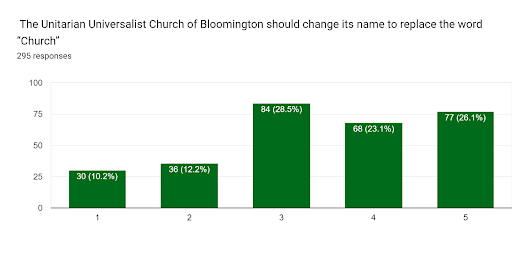
The reasons given by those in agreement with the change (groups 4 & 5, 49.2%), fell under two general themes:
- Lack of inclusivity. The most common response focused on the idea that “church” is strongly associated with Christianity and is not inclusive to those from other faiths, have been unaffiliated, or are agnostic or atheistic.
- Negative association with the word “church.” The word itself can be distressing or even traumatizing for those who had negative experiences tied with Christian religion.
For those who were neutral (group 3, 28.5%), the following themes arose:
- No compelling reason for change. These responses were essentially non-committal.
- Can see both sides of the argument. The concern was that both sides of the argument made legitimate points and neither side pushed or pulled them over.
- Need more information to make a decision. This group wanted to know more before they made a commitment.
- Have continuing questions about the impact. They were concerned about broader impacts of the change.
For those who disagreed with the change (group 1 & 2, 22.4%), responses fell under these themes:
- “’Church’ describes in a single word what we are.” This quote represents the most common theme in this group, in that “church” was seen as a commonly recognized identifier for a group of people who follow a common religious tradition.
- It reflects our Christian-based history, better to change people’s understanding of what “church” means. This reflected a concern about abandoning our roots and ceding “church” to others.
- Concerns about how this affects how we are viewed in other contexts. These included risking our tax-exempt status and our standing with other faiths.
- Labeling or branding. What do we call ourselves? How do we refer to our grounds and building?
For the second question, we asked “If the change takes place, what will we replace “church” with? We offered four forced choices (community, congregation, fellowship, society) and an open-choice “other.” “Congregation” was the first choice, with “community” not far behind. The other two were far less popular and have been dropped from consideration. Another option that was volunteered most often, was to call ourselves “the Unitarian Universalists of Bloomington.” This option will be included in discussions.
So, what is next? We need more input from you. We need to address questions that arose from the survey and, more importantly, we need to know more about what you think and feel about the potential change. For this we are arranging in-person listening sessions and Zoom session.
Currently scheduled:
- Two in-person listening sessions
- January 18, 2026, at 2:00 PM
- February 15, 2026, at 2:00 PM
- At least one evening Zoom meeting.
We look forward to hearing from all about this potential change.
From the Homelessness Task Force
The Heart of the Commons
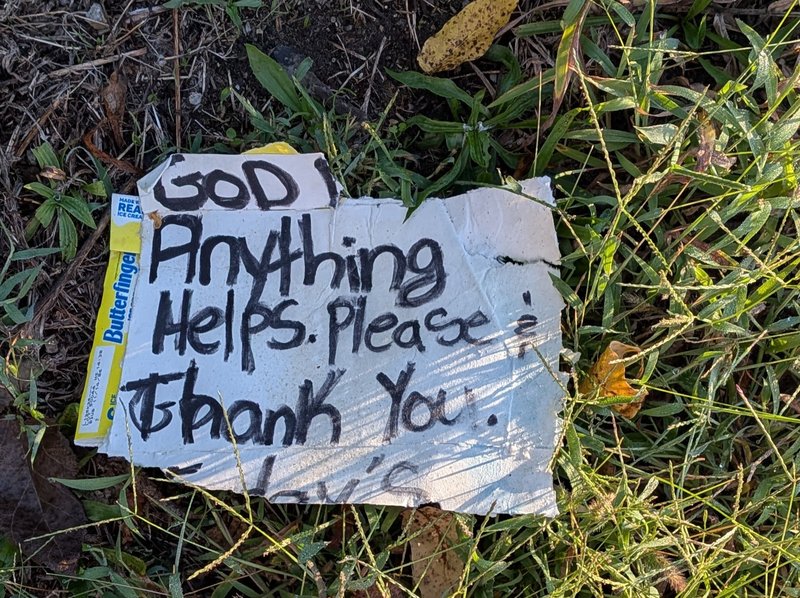
The thermostat of the church kicks on and the overnight guests enjoy the life-saving comforts that the shelter provides. This is not UUCB, mind you, but the Bloomington Severe Emergency Winter Shelter (BSWERS). We need these shelters because of the lack created by radical insufficiencies in our society. We touched on this briefly in our last perspectives article, but I’d like to step back for a moment to talk about what causes these structural issues and how you can help act to change this situation rather than merely react to it. When Thomas Horrocks was running as a candidate for District 62 in the Indiana House of Representatives, one of his campaign slogans was “Charity can’t fix what bad policy creates,” and so our task force is focused not just on reaction but also prevention.
The reality is that our local community faces more limitations than opportunities with regard to program funding and dispersal of funds. Of note, many of the funds supporting Beacon’s permanent supportive housing programs are being reappropriated and the criteria for meeting the prerequisites for funding are ever-changing, scaling back harm reduction practices that help address the root causes of homelessness–particularly the Continuum of Care programs that includes Emergency Support Grants. Moreover, even the grants themselves are being scrubbed from government websites <cf. https://www.nahro.org/news/coc-fy25-nofo-removed-from-hud-website/> And while our congregation has done very well to support the development of Beacon’s new center, the city funding sources that their Rapid Rehousing program currently runs on are not being appropriated to Beacon–even as they are appropriated to other organizations <cf. https://bloomdocs.org/wp-content/uploads/simple-file-list/2025-11-20-Thomson-Report-Housing_Investment_Report_20251120_chk.pdf#page=8 >.
The Homelessness Task Force has had separate meetings with Senator Shelli Yoder and State Representative Matt Pierce this past month along with the Hunger and Democracy task forces. In these meetings, we’re trying to establish relationships with our state representatives to improve the structures of our sociopolitical landscape. And yet, we face many barriers that stymie even our humble efforts to improve the community, let alone to be “Changing the World.” But we won’t lose hope: we just return to what we can do within our capacity.
So what can you do? All this sounds quite complicated, but many small voices can make a big noise. If you want to join us, the National Alliance to End Homelessness makes it easy. In this auto-generated form, their website will identify representatives in the House and Senate to reinstate funding for critical programs until a better solution can be devised <cf. https://endhomelessness.org/action/enough-is-enough/>.
We strongly encourage you to write to these sympathetic representatives. Please don’t hesitate to contact us with any questions or concerns, but the more people we can get sending these letters, the better capacity we’ll have to shape the world we want–one that draws more people into a commons where love is at the center. Please contact us using this contact form or come to our meeting at 1 pm on January 4th (first Sundays) in the church library.
From the Racial Justice Task Force
Author Milagros Phillips writes:
“Anti-racism work gives an understanding of the fundamental structure of our racial systems. It wakes people up to the realities of racism and its impact on Black people, Indigenous people, and People of Color, also known as ‘BIPOC’. Anti-racism work is much needed, but it often leaves participants stuck in guilt, shame, and anger. This prevents them from moving forward and doing the vital work needed to change our society. Remember, racism is a problem for People of Color; it is not the problem of People of Color. To solve racism, the whole community needs to be involved. We can’t afford to leave anyone behind.”
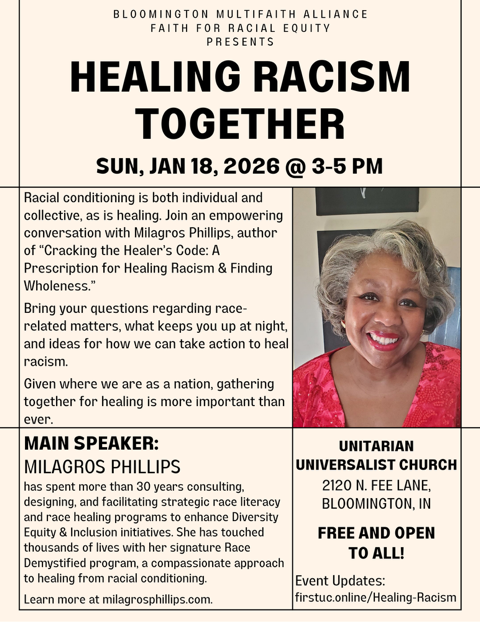
The racist rhetoric and policy changes in our country make “the vital work needed to change our society” even more urgent. Through the efforts of the Bloomington Multifaith Alliance Faith for Racial Equity group, we have the opportunity to be in community with each other - and with Ms. Phillips (virtually) - to explore Healing Racism Together at 3pm on January 18th in our UUCB Meeting Room.
Ms. Phillips has invited us to bring questions regarding race-related matters and what keeps us up at night to this afternoon of conversation. From her 30+ years facilitating race literacy and racial healing programs, she will help empower us to find ways we can get unstuck and work for a society that brings us together rather than keeps us apart. Please join us. “We can’t afford to leave anyone behind.”
Midwestern Unitarian Universalist Summer Assembly
A Summer Camp for All Ages!
The Midwestern Unitarian Universalist Summer Assembly (MUUSA) is an intergenerational, week- long "camp" for Adults, Young Adults, Senior High School, Junior High School, Elementary, and Early Childhood campers. The dates for this year's assembly are July 5-11, 2026. MUUSA is a place for spiritual reflection, intellectual growth, and creative play within a caring and supportive community.
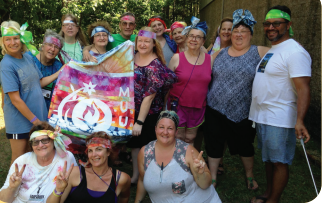
Adults enjoy a long list of workshops and excursions. Teens live separately from adults with their own counselors and their own programming based on their year in school. Our youngest children enjoy day long activities and religious education and rejoin their families at the end of each day. Teens may attend either with their families or with church "sponsors."
Multigenerational activities include social hours, dances, open-mic "Coffeehouse," games, and spiritual meetings.
All inclusive registration fees include housing, meals, workshops and other activities.
MUUSA (and before that LGSA) has enjoyed close relationships with small college campuses. LGSA made Aurora College home in Williams Bay on Lake Geneva, while last year we held a "mini-MUUSA" here at UUCB. Now we are excited to be moving to the campus of Ripon College in Ripon, Wisconsin.
Ripon is a small, historic town, snuggled right up to campus. Home to Knuth Brewing, quaint ice-cream shops, a Clydesdale Horse farm, a 140 acre restored prairie, and a beautifully restored mill and mill pond, Budget Travel Magazine named Ripon "one of the coolest small towns in America." It's also been named a "Tree Campus" by the Arbor Day Foundation.
Ripon is just 1.5 hours northwest of Milwaukee and about 30 minutes from the Lake Winnebago towns of Oshkosh and Fond du Lac.
The campus sits on 250 wooded acres; 10 buildings are on the National Register of Historic places. Athletic facilities include basketball courts, a 25 meter pool, large fitness center, soccer/frisbee field, and an E-sports center. Also on campus are two art museums and creative centers. Ceresco Prairie includes miles of prairie and wooded trails for both walking and biking.
Many UUCB families are long-time MUUSA attendees. They are excited to introduce you to what has become an important part of a UU based spiritual, recreational, social, and creative week that they look forward to all year. Good resources for information about MUUSA are Guy and Connie Loftman, Steve Krahnke and Jane McLeod, Carol Marks, Ruellen Fessenbecker and Ann Kamman.
For more information, go to MUUSA.org, or download the informational brochure by clicking here!
A Memorial Garden Memoir and Update
About twenty-five years ago my husband Ed and I began the Unitarian Universalist Memorial Garden. We don’t like to see neglected spaces and the small piece of land between the end of the R.E. building and the parking lot definitely fit into that category. Why a Memorial Garden? Our recent congregational themes, sanctuary (December) and gratitude (November) are quite relevant. Ed and I were first attracted to UUCB because of all the exceptional folks here who were involved in the most worthwhile causes in Bloomington, especially social justice ones, some of whom appeared on our doorstep inviting us to belong to a welcoming community. They are now our Unitarian Universalist ancestors, worthy of celebration. And, every Sunday we pay our respects to Native American/First Nation cultures, whose land our ancestors took and we keep. Their cultures teach respect for the ancestors and the land, including meditation practices. It is good to have an outdoor quiet place a bit removed from church and home activities. We have much to be grateful for, however turbulent the times and toxic the politics. It is also good to take time out from hectic lives to sit quietly and meditate/contemplate; the Memorial Garden is intended to surround its users with calm beauty to enrich our lives. We are so grateful to those who have helped over the years.
History
By 1990 the area between the end of the RE building and the parking lot was an overgrown space full of creeping juniper and weeds. A 10 foot high cement wall allowing access to a back door to the building posed safety issues for children who walked up the slope on it. So, we designed the space to be separate from the already roomy playground occupying the courtyard. Beautifying it was a communal effort. Dan Willard, Guy Loftman, Edryce Baker, Ann Kamman, and many others provided input and helped. Many donated plants. We set up a special purposes fund to handle maintenance and improvements, to which others are welcome to donate. In addition, Ed and I gave each other the anniversary present of plants for the initial landscaping. Much communal labor implemented the landscaping plan. We removed tough old juniper with 5-inch trunks and countless weeds, some of them toxic. We did necessary terracing of the slope. We planted bushes and flowers, some of which screened the area from the parking lot. The Women’s Alliance donated a handsome stone bench that now sits under the small tree at the lower edge of the Garden toward the parking lot.
This was the situation until 2012 when drainage issues became critical; the Garden was torn up, including the greenery bordering the parking lot, the back door and the dangerous wall removed, and pipes and drains installed to handle the water from the roof. An expensive irrigation system was put in. About a fifth of the area at the bottom along the sidewalk was paved over, and a was tree removed. The church hired a landscape architect from Indianapolis to design a new garden. I have a thick folder of long letters written to the Church Committee to hand on to him stressing the Garden’s functions for contemplation/meditation and the need to accommodate the benches, for instance. Unfortunately, these needs were not met. Although the new Garden did a good job with the drainage elements like the grasses, and added interesting large rocks, it did not include benches or a good view of the Garden, and so it lost much of its meditative function. There was no provision for entering the Garden. The rock terracing had also been removed, for unknown reasons. Does anyone else remember the large pile of removed rocks in the back corner of the parking lot?
As a result we set up a Memorial Garden Committee to deal with further necessary Garden renovations. The Committee consulted with other interested folk, and decided to use the Memorial Garden Special Purpose fund to remedy the problems but leave in place the large rocks and the grasses. We originally were going to have a small walkway going through it, but that idea was stopped with concerns about safety, given the slope, the walls, the trees, the irrigation pipes, the AC units, etc. We moved the serviceberry bushes to the back edge of the property, and planted large trees along the end of the parking lot to screen the Church and lot from highway 46, all of which are flourishing. We replaced the needed rock terracing and planted evergreens to screen the Garden from the parking lot, and a large American lilac at the top, as well as several smaller ones and some other bushes and smaller plants including flowers. We tried to use bushes to screen the industrial air conditioner area for aesthetic reasons. We planted two smallish Japanese maples, one of which shades the lower bench. We made the upper stone bench out of the aforesaid stone. We don’t use toxic chemicals on it, although that means more labor is required to maintain it. We remove thistles and other invasives. A sign announcing that the space is in fact a memorial garden was installed. We had lots of necessary help from volunteers in the best tradition of Unitarian Universalism.
Issues
Since the Garden renovations, the communal group doing maintenance, along with many others, have enjoyed the results. We have tried to follow Dan Willard’s mandate not to rely on paid labor but encourage cooperation. However, finding volunteers to maintain it has become increasingly difficult in recent years. The usual crew is aging, with many commitments elsewhere and not as physically able as we were. The lack of drainage behind the concrete wall at the bottom badly needs remedying, and the wall needs to be repaired; the bushes we planted as a natural screen around the AC units have died and need to be replaced. However, the income from the original fund is not sufficient. We still believe that there should be a dedicated quiet space on the church grounds, including for children, who can learn meditation practices and respect for natural surroundings.
We need a new Memorial Garden Committee, and a stable group of volunteers to work on maintaining it. We hope there are many who would like to contribute to keeping this tradition going for everyone’s future enjoyment. The labor commitment per month depends on how many volunteers we have, but it should never be more than two hours twice a month, mainly in the spring and fall. As Unitarian Universalists believe, communal labor, collaborating on projects, and even (some) meetings not only produce results, but also build community. Interested? Please call Claire at 812-336-3696, preferred, or 812-340-4522 (yes, be revolutionary and actually phone rather than email). The current committee would love to have lively discussion about the Memorial Garden, and, best of all, help with developing and maintaining it. Thanks for participating in our community and listening.
Claire Robertson, 11/2/2025
Upcoming Services
January 4, 2026
All Ages Service: The Courage to Be You
Rev. Susan Frederick-Gray
We welcome the New Year with story and song and an invitation to consider the hopes and the gifts that we can bring with us to shape the New Year.
January 11, 2026
How We Build Courage
Rev. Susan Frederick-Gray
What does it mean to be a courageous person and how can we grow our own courage? How can community help us?
January 18, 2026
MLK Sunday: The Courage to Love
Rev. Susan Frederick-Gray
Martin Luther King, Jr. spoke of the strengthen needed to choose love in the face of hate and discrimination. In honor of his birthday, we reflect on his teachings of the centrality of love and the courage it takes to choose love.
January 25, 2026
Courage in Unexpected Places
Rev. Sarah Gettie McNeill
Deep wells of courage are all around us, all the time, if only we are able to attune our spirits to Source. It is easy to feel overwhelmed and overly responsible for our world and it is important to remember that we do not go this road alone. In this service, we will explore different understandings of Source and how we might draw on That Which is Greater Than Us for spiritual nourishment.
