Perspectives for October 2026
- From Rev. Susan: We Need Pride and Humility
- What I'm Learning About Being New
- Education Matters: How Do We Restore Right Relationship with Indigenous People?
- From the Board: Annual Retreat Reflection
- Pride, Humility, and Winter Shelters
- Diaper Equity
- Fall Social Justice Grants
- Building Community: Fellowship Dinners
- JJ Watson and the Courtyard Oak
- Upcoming Adult Religious Exploration Offerings
- Upcoming Services
- Attendance, Offertory, and Membership Information
Table of Contents
From Rev. Susan: We Need Pride and Humility
I’ve been thinking a lot about pride and humility lately. Watching the news and some of our leaders’ self-aggrandizement and disdain for others reminds me of the ancient myths that teach the dangers of excessive pride. After all, pride is one of the seven deadly sins. Pride, when defined as a deadly sin, means “an excessive and self-focused belief in one's own abilities or importance, often breeding contempt for others.” We have a lot of examples of this right now. And it can show up in any of us as well, especially when we think we know it all, or denigrate those who think or believe differently than we do.
This has led me to want to talk about humility as a theme this month. And why cultivating humility – recognizing the value, the dignity, that each person has – is such an important characteristic. But, at the same time, too many people have been told to be humble in a way that means “be quiet, make yourself small, put yourself below others.” Just like excessive pride, this too is dangerous. This way of understanding humility can stifle one’s spirit, joy, and the gifts one has to share. It can cause us to let our light go out, rather than shine brightly and proudly. So this month, our theme is Pride and Humility, recognizing that there must be a balance that celebrates the need for both pride and humility. Pride as in self-love and confidence, knowing that we are valuable just as we are; and humility that recognizes that this is true for others too.
In a time when arrogance and disdain for others is getting so much of the oxygen and attention in our political world, we as a moral and spiritual community must cultivate a middle way. We recognize that both pride and humility are needed, and there is power and strength to be found in living with both in balance.
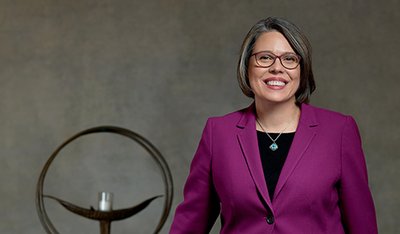
Rev. Susan Frederick-Gray, Lead Minister
revsfg@uubloomington.org
What I'm Learning About Being New
By Maria Renner, Ministerial Intern
As I begin my third week as Ministerial Intern, I’ve been reflecting on transitions, on what it means to be new, and on what I’m learning from this experience.
Beginning an internship has given me the opportunity to hold two truths together. I am bringing my own background, knowledge, beliefs, and gifts that don’t go away because I am new. And I am entering the UUCB community, shaped by more than 75 years of history, relationships, traditions, and wisdom that I am just beginning to learn.
I’m starting to see how Pride and Humility can exist together in being new. Being new doesn’t mean setting aside what I already know or everything that has brought me to this point. But my perspective is still only my own. There is a lot I don’t know about this community yet, and probably things I don’t even know to ask about.
I wonder if this is true not only when we enter a new community, but also when we have belonged to one for a very long time. I’m curious what it means to be part of a community with enough pride to value what we have built, while also having enough humility to remain open to being changed by one another.
Humility may not be about making ourselves smaller. And perhaps pride does not require certainty that we are right. Maybe both ask us to see ourselves more fully: to recognize what we carry, while remembering that others carry their own stories and perspectives that we need too.
As I continue getting to know UUCB, I am learning that being new offers its own kind of spiritual practice: listening before assuming, asking questions when I don’t know, offering what I can, and allowing what I encounter here to change me.
I suspect that the balance between knowing and not knowing, contributing and receiving, speaking and listening is something I will be practicing long after I am no longer new.
Education Matters: How Do We Restore Right Relationship with Indigenous People?
Recently, the Indigenous Studies Working Group hosted an event to watch portions of Ryan Conway’s sermon delivered at UUCB on June 14, 2026, specifically listening for what he called on us to do to help restore right relations and work toward justice. If you missed that service, or even if you were there, I encourage you to watch the video. The sermon starts around 58:43 in the video, and is rich enough to bear repeating many times.
Ryan, a Shawnee enrolled member who is working to restore native culture in Indiana and beyond, made some specific suggestions for those of us who wish to repair damage done by settler colonialism and the policies and practices that continue today.
- Learn the history. The US government’s treatment of native peoples was brutal, deceitful, and devastating. But the point is not for us to feel guilt or pity; the point is rather to understand the past so that we can better understand the present. Our actions must extend from our knowledge, not from partial truths or generalizations.
- Facilitate the repair of relationships between native peoples and the land.
- Rekindle our own connections to the land. All of us come from ancestry that, somewhere in the past, was indigenous (“of the land”), but for most of us, those relationships were severed long, long ago by empire, feudalism, colonialism, and capitalism.
- Allow our lives to be reorganized by the truth of interdependence. One of the core shared understandings of many if not all indigenous peoples is that we exist in a kinship relationship with all creatures – human and more than human – plants, water, air, fire, rocks, the earth, the sun, the moon, our ancestors, and the ones not yet born. Many of us find this to be a beautiful and indisputable idea, but Ryan isn’t asking us to simply agree with it. He is asking us to reorganize our lives around this perspective. If birds are our kin, how can we not address light pollution that disrupts their night migration over our city? If the Earth is our Mother, how can we perpetuate an economy based on extraction and land ownership? If water is sacred, how can we allow data center construction that pumps heavy metals and PFAS into our rivers and streams?
- Do the work of repair. This includes repairing the damage done to the earth, water, and air; repairing relationships with native peoples and all our more-than-human kin; and helping to repair relationships among scattered indigenous peoples. A very concrete way to start is to help bring the corn, and the native peoples who belong to it, back to Prophetstown. You can read more about the Shawnee Seed Sanctuary here, and listen to Ryan’s history of Prophetstown at 1:14:54 in his sermon.
So, how can we here at UUCB engage with these actions? The Indigenous Studies Group is offering many learning opportunities throughout the year. There’s the Forum, meeting roughly once a month for a presentation and discussion of a particular topic. The Indigenous Studies Book Club meets on the second Monday of each month, and members take turns presenting a book (no preparation required, though others are welcome to read the book in advance if they like). You can also check out our recommended reading list, visit local museums, and attend our worship service honoring Indigenous People’s Day on October 11. And you can familiarize yourself with present-day issues, efforts, and perspectives of Indigenous People by reading and supporting Native News Online.
You can rekindle your connection with the earth by researching your own ancient roots, and/or by simply building your relationship with the land you occupy now. Get to know the plants, bugs, birds, and animals. Pay attention to the moon and the path of the sun. Pause in the morning to greet the new day and in the evening to greet the night. Learn about the local ecosystems. Attend equinox and solstice ceremonies to honor the changing seasons and heighten your awareness. Practice gratitude. As Mary Oliver writes, “Attention is the beginning of devotion.”
As you build your relationship with the natural world around you, be mindful of the impact your own actions have on your kin. Advocate for the earth and all her creatures. Recommit yourself to lowering your carbon footprint, consuming less, wasting less. Yes, all these things are part of building relationships that restore justice. Settler colonialism wreaked havoc on this land and her peoples hundreds of years ago and settler colonialist mindsets are continuing to do devastating harm today. We cannot restore justice at the same time as we continue to harm.
Finally, you can support the Prophetstown Seed Project with your labor, time, and funds. On November 6, you can join the work party at Prophetstown preparing for the harvest and celebration. On November 8, you can help braid the ears of corn and join in other harvest-related tasks, and then celebrate alongside members of the many tribes returning to Prophetstown for this gathering for the first time in over 200 years. Between now and the end of November you can make a donation to the Church for the Shawnee Seed Sanctuary, either online or by writing a check with “Shawnee Seed Sanctuary” in the subject line. We are trying to raise at least $8000 to help with the expenses related to supporting Shawnee elders and others attending the historic November Prophetstown gathering.
We, the congregation of the Unitarian Universalist Church of Bloomington, have made a commitment to build relationships that restore justice, and we proclaim this commitment in our worship service every Sunday. These are some of the ways we can all put those words and values into action. We hope everyone will be a part of it.
From the Board: Annual Retreat Reflection
The Board held its annual retreat in September. At the retreat we spent time reviewing our covenant, building deeper bonds with one another, and solidifying our goals for the coming year. One of those goals is to engage in the work of mission and vision discernment. The Board is using the powerful questions time at our meetings as one tool to explore who we are as a congregation and who we want to become.
We deeply appreciate the work of the Mission-Vision Discernment Working Group and the Name Change Discernment Working Group over the last year. Their work helped the Board understand the need to have a clear vision for the congregation to guide decision-making. The Board is prioritizing mission and vision discernment this year because we believe it will provide a solid foundation for other decisions, including the name change conversation. If we know where we want to go as a congregation, we can better determine what name fits that vision. At the August meeting, the Board decided to table the name change conversation for the next year while we turn our focus to vision and mission.
The Board and Rev. Susan will host a Cookies and Conversation on October 25th between the services in the library. Please bring your questions and comments about the pause in the name change conversation and how it fits in with vision and mission discernment. We hope to see you then.
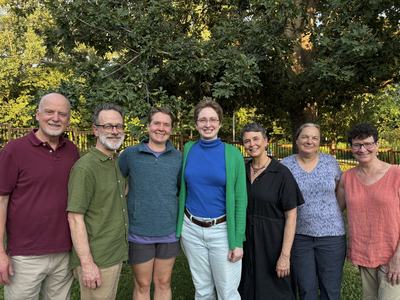
By Sarah Kopper
Board Member-At-Large
Pride, Humility, and Winter Shelters
Social Justice Moment from the Homelessness Task Force
Our faith tradition has long recognized our commitment to affirm “the inherent worth and dignity of all living beings.” When it comes to people experiencing homelessness in the treacherous conditions of winter weather amidst insufficient material resources, this principle is a challenge to sustain. However, Sacred Heart Pastor Dan Caldwell with the Bloomington Severe Weather Emergency Response Shelter (B-SWERS) demonstrates a commitment to humility that offers hope to material conditions that seem to worsen every year.
Talking about the human connections he forms with guests of the shelter, Caldwell has said on the 812 show that “When you get to hear peoples’ stories, the so-called ‘bad choice’ [that people claim they made] is really the best choice that’s available to them.” This means that to truly recognize the false pride we have in making good choices is a barrier to the radical humility of not just serving our fellow unhoused neighbors as equals in status, but as humans with unique challenges and histories who are also deserving of compassion as fellow humans.
At UUCB, we speak of the commitment to be welcoming “regardless of how much money you have in your pocket.” The homelessness task force strives to do that in many ways, both within our congregation and in the community. In addition to raising money for organizations and collecting donations, many members of our congregation have regularly served with B-SWERS (and its predecessor, the interfaith winter shelter) to help offer the services of an overnight, low-barrier shelter. The shelter opens when temperatures drop below 25° F to provide refuge from the elements of winter and a vital way to survive when the other shelters are full.
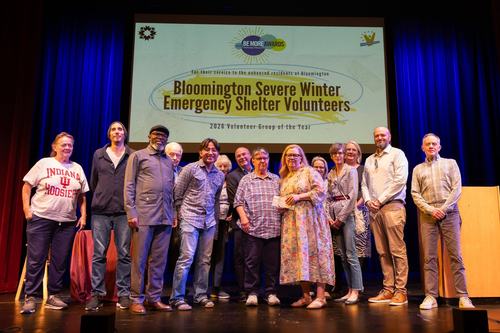
Jason Lopez (of the Homelessness task force) was recognized this last year with fellow volunteers with a Be More Impactful award from the city of Bloomington (see photo). When I asked about how he considers pride and humility playing into this, he said, “BSWERS is saving lives. Being involved in such meaningful work can make you feel both proud and humble at the same time because anyone can suddenly lose their job, have a medical emergency, or family tragedy and become unhoused.”
If you want to learn more, you can come socialize with volunteers, coordinators, and supporters of the shelter at the B-SWERS Jamboree on October 10 from 3-6 pm on the front lawn of the First Christian Church on the corner of Kirkwood and Washington. They will have live music, “yummy food,” and “all ages fun,” according to their Facebook event page. All money raised goes to support the BSWERS shelter so we can provide a warm safe place to sleep on the coldest nights of the winter. Most importantly, you can represent the interfaith link that UUCB adds to the community while you experience a greater sense of purpose in the ways you show up in community, from our congregation to the yards and streets of Bloomington.
Lopez reminds us, “We must always remember to be understanding and treat the individuals we're helping with dignity, respect, and as equals. The work also helps me to appreciate the people in my own life who I can count on for support if the need arises.”
In addition to volunteering through the winter months, you can become involved with our task force in many wonderful ways by checking out our task force page and coming to our monthly meetings or contacting our chairs Mary Blizzard, Jason Michálek, or Barb Backler using this form. Thank you for your help in building community that changes the world!
By Jason Michálek
Diaper Equity
From the Reproductive Justice Task Force

What is Diaper Equity? Is there something I can do about it? Yes!!! October is the Reproductive Justice Task Force’s annual diaper drive for our local diaper bank. Here’s why there’s a critical need and information on how to help.
Diapers are a fact of life and in a world of inequality, the gaps can make or break a family’s situation. Let’s look at how this works. Nearly 8 million children (47%) in the US live in families that struggle to buy enough diapers. Foodstamps (SNAP benefits) do not cover them. The reality is that children cannot attend daycare unless accompanied by a sufficient number of diapers and wipes. Cloth diapers are not allowed. So, parents miss work and school, falling further behind in their economic situation.
There are also health issues related to diaper equity when wet diapers are kept on too long to save on costs or are even ‘washed’ between uses and are not really clean. Caregivers suffer from anxiety and shame because of the situation, often juggling the choice between diapers, food, or utilities.
Please consider a donation to Tandem’s Hoosier Diaper fund by either dropping off supplies of diapers and wipes at Tandem or donating funds online; information on both can be found here.
Nan McKinley, co-chair of the Reproductive Justice Task Force
Fall Social Justice Grants
It’s time to consider applying for a fall social justice grant! Think of ways our congregation can make an impact on Monroe County. Applications are available now (as a PDF or Google Doc) and will be accepted through October 31st.
When evaluating grants, the Social Justice Funds Committee considers:
- Does the grant involve a Social Justice task force?
- How many UU members are involved?
- Is it consistent with the mission of the congregation?
- Does it empower the organization to empower others?
- Is this seed money rather than for maintenance?
- Will our contribution make a real difference in their budget?
- Do they have finite goals?
- Have they received UU social justice grants in the past?
Please note: the monies cannot be used to pay for professional services or salaries.
Fall Grants announcements are made in mid-November and the recipients have one year to use their funds. Unused funds return to our Special Purposes fund.
Please reach out with any questions!
UU Social Justice Funds Committee: Sarah Kopper, Steve Mascari, MJ Wallaker, and Paul Banister
Building Community: Fellowship Dinners

Sign up is now open for 2026-27 Fellowship Dinners!
You can sign up to participate here: https://forms.gle/fRLhquqHM6CyfY2H6
Here are some answers to our most frequently asked questions.
What is a Fellowship Dinner?
At Fellowship Dinners, you share a potluck meal with a small group of friendly UUs in someone’s home. Once or twice a year you host a group. Single or paired, you are welcome at Fellowship Dinners! While it is called a Fellowship Dinner, the shared meal could be a brunch or an afternoon picnic, if that works better for everyone's schedules.
How does it work?
Each month, the Fellowship Dinners coordinator sends a list of guests to the host, who then contacts the guests, establishes a mutually agreed upon date for the meal, and provides the main dish. The guests either volunteer or are assigned the rest of the dishes for the meal: appetizers, salads, vegetables, desserts, beverages, etc.
Fellowship Dinners are focused on just that, fellowship over a shared meal. In fact, the fellowship aspect of the meal is probably the most valued part of the experience! This is not a gourmet dining club. Pressed for time? Don't like to cook? Bring a dish from a deli or order a pizza!
When you are the host and are scheduling dinners, please remind any couples that they should think of themselves as two units, not as a single unit when mapping out who will contribute what to the dinners.
How often do I host?
Everyone who participates in Fellowship Dinners will host at least once during the year, even if you do not have a space to host in (see next question). Depending on how many people sign up, many of you might host once in the fall and once in the spring.
What if your house and table are small?
Some folks with small or distant homes might make arrangements to host in someone else’s (larger, closer) home. Some of you do not have a space that is available/appropriate for hosting a group of any size; the coordinator can help match you up with those of us who feel comfortable providing their home as a venue for those without a space to host the dinner. Anyone acting as a venue provider will then function as a guest. Finally, hosting is an enjoyable experience; however, you don't have to host if you have limitations that cannot be overcome. Let the coordinator know that.
When are Fellowship dinners?
Dinners happen on a monthly basis. If you cannot make it every month, you can still sign up! Dinners will start in September and continue on through May of 2027. Please let us know in the section below any months you know you cannot make.
I have kids. Can I still participate?
Yes! Many hosts are happy to have kids come and be a part of the dinners. For hosts who are not able to accommodate children, the Fellowship coordinator may be able to help find childcare, either in your home, or possibly at church.
I am not sure I am ready for this sort of commitment. Can I just try one month?
Yes! This year we are going to leave space at the table for new people, or people who are not sure Fellowship Dinners are for them. Come give it a try, and if you love the experience, sign up for the whole program! In the form, just indicate the month you want to try, and then let me know in the comments that you are just trying it out.
More information
Coordinator: Abby Gitlitz, fwpdinners@uubloomington.org
JJ Watson and the Courtyard Oak
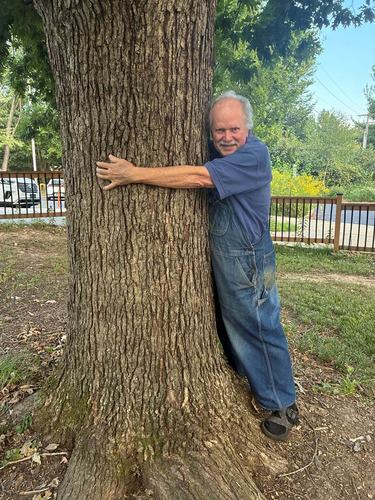
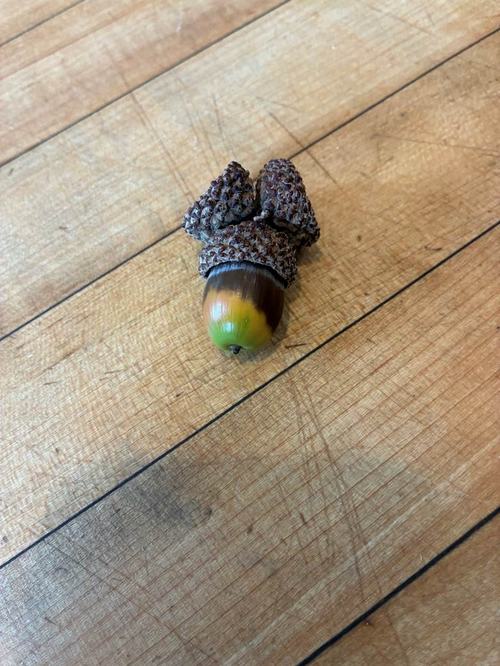
On September 19, 2026, I presented this as the Time For All Ages at the Unitarian Universalist Church of Bloomington, Indiana.
Guy Loftman
JJ Watson and the Courtyard Oak
Kids, I want to tell a story about this acorn.
I’ll start back in 1977, when my wife Connie and I joined this church. At the time, JJ Watson was a treasured member. He had served in the US Navy during the Vietnam War, where he became a Lieutenant Commander, and was awarded the Bronze Star. He was very much a Navy man, demanding of himself and others.
The Vietnam War had recently ended, and many people in our church had strongly opposed it, including me. I’m a pacifist. That means I don’t believe in fighting wars.
Because of that, I wasn’t forced to join the Army. JJ knew these things about me, and I knew that he had served in Vietnam. I knew he was a Republican, and he knew I was a Democrat. We were very different, but we liked each other, and became good friends.
I think it was in the Fall of 1982 that JJ told the church that he wanted to plant a tree on our grounds in memory of his son, Robert Watson, who had died in a car crash. JJ wanted somebody to help him choose the tree, dig it up, bring it to the church and plant it. I was president of the church at the time, so he asked me who I thought might do it. Of course, I said I would. I was glad to help, but knowing JJ, I knew it wouldn’t be particularly easy.
JJ and his wife Roberta lived on a farm out in the country in Greene County, about 15 miles west of Bloomington. I drove out there and got into his pickup truck. Then we bounced around the farm, looking for the right tree. It was Fall, and the leaves were mostly down.
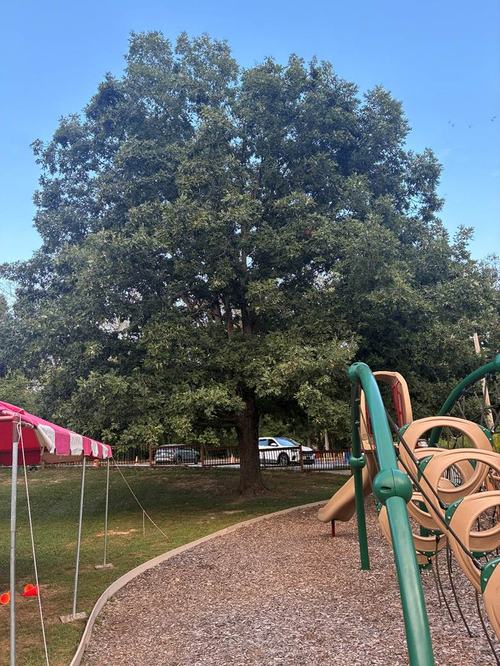
Before too long we found a sturdy White Oak, maybe 6 feet tall with a nice shape and straight trunk. A white oak has a long tap root that grows straight down into the ground. If we didn’t get close to all of it, the tree would die. We dug and we dug, deeper and deeper, in a circle all the way around the tree. Finally JJ said, “Good enough.” Then we hauled it out of the ground, dragged it to his pickup truck, lifted it in, latched the tail gate, and drove to the church. Then we had to dig a hole even deeper and wider than the root ball, so we could fit it in. So we dug again for a long time, till JJ finally said, “Good enough.” Then we put the tree in the hole, packed dirt around the roots, left a circle of dirt around it as a dam, and gave it a great big drink of water.
Apparently we dug deep enough, because that tree is still there, and it has grown large. It stands in the southeast corner of our courtyard. You can see it there every time you come to church. Maybe you have played underneath it. I picked this acorn from it. I like to hug it.
People say when you plant an oak you shouldn’t expect to sit in its shade, because they take a long time to get big. But I’ve been able to sit in the shade of this oak. Maybe you’ll have a chance to hug it when you’re 81 years old, like I am. But you don’t have to wait. You could hug it today.
Upcoming Adult Religious Exploration Offerings
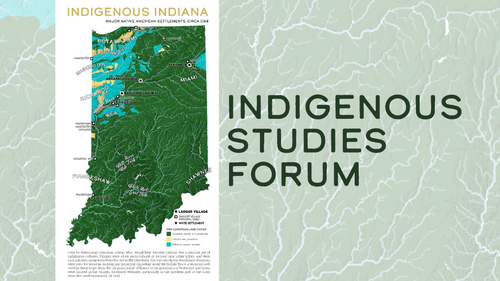
Indigenous Studies Forum
Tuesday, October 6, at 7 p.m. in the UU Library
The Indigenous Studies planning group is offering a monthly forum on Indiana’s Native Americans. The topic on October 6 is “Stories of Native Resistance to European Encroachment.”
(Re)claiming Your Spiritual Journey
Tuesday, October 6, at 7 p.m. in Room 208 (continues Oct. 13 & 20)
Many people come to Unitarian Universalism from other faith traditions that didn’t serve them well and may have done them harm. But if we do not confront our religious past, heal from any trauma it caused, and distinguish the helpful from harmful aspects of it, we’re likely to remain stuck and deny ourselves the richness of an integrated faith. This class offers a chance to explore your story, intentionally processing the good and the bad so that you can harvest what’s helpful and be free of the rest. If you are interested but unable to make the currently scheduled time, please register anyway, choosing that option!
Exploring Daoist Philosophy
Wednesday, October 7, at 7 p.m. in Room 208 (continues on Wednesdays through Nov. 4)
After covering the basics, we'll dive deep into ziran ("natural spontaneity"), a deep idea that the purest things act freely, of themselves, without outside imposition. Expect poetry, ancient but approachable texts, laid-back presentations, and open discussion facilitated by Zach Ammerman. All faith backgrounds (and none) welcome to explore this non-theistic philosophy. Appropriate both for newcomers and for those who took the previous Daoism course last spring.
Upcoming Services
Sunday, October 4, 2026
Balancing Pride and Humility
Rev. Susan Frederick-Gray
With a weekend full of celebration – Lotus Festival, Spencer Pride, Resilience Productions – we celebrate pride in our community, LGBTQ+ pride, pride in history and diversity, and the work for justice we do today. And we recognize how humility is not separate from pride. Together, in balance, they are a strength.
Musical guest: Sarah Dan Jones. Sarah Dan, the composer of the beloved UU song “Meditation on Breathing” is the Director of Music Ministries at the Starr King UU Fellowship in Plymouth, NH.
Friday, October 9, at 4 p.m.
Memorial Service for Barbara Restle
A Memorial Service for Barbara Restle will be held on Friday, October 9, at 4 p.m. in the Meeting Room. A reception will follow in Fellowship Hall.
Sunday, October 11, 2026
Indiana, Land of the Indians
Dr. Stephanie Kimball and the Indigenous Studies Working Group
Euro-American and traditional indigenous attitudes toward land differ greatly: One sees it as property, as something to control and conquer; the other sees it as a partner, as something to nurture and live alongside. What can we learn from the latter?
Sunday, October 18, 2026
Rediscovering Humility
Rev. Susan Frederick-Gray
Humility is an important characteristic of spiritual and psychological maturity. Yet it is often misunderstood in ways that cause people to diminish themselves and their own light, joy and confidence. How can we understand humility in ways that are life honoring?
Friday, October 23, at 1 p.m.
Celebration of Life for Pat Harris
A Celebration of Life for Pat Harris will be held on Friday, October 23, at 1 p.m. in the Meeting Room. A reception will follow in Fellowship Hall.
Sunday, October 25, 2026
I Could Be Wrong
Maria Renner, Ministerial Intern
In this sermon we will explore how the willingness to say “I could be wrong” can make room for curiosity, relationship, and the possibility of being changed.
Attendance, Offertory, and Membership Information
Current Member Number: 501
Quarter 1 Farm to Family Offertory Total: $2,433.49
Attendance Totals in July
7/05/2026: 165
7/12/2026: 157
7/19/2026: 115
7/26/2026: 219
Attendance Totals in August
8/02/2026: 177
8/09/2026: 248
8/16/2026: 121, 131
8/23/2026: 120, 148
8/30/2026: 103, 141
Attendance Totals in September
9/06/2026: 86, 87
9/13/2026: 116, 155
9/20/2026: 116, 127
9/27/2026: 107, 130
