Perspectives for February 2026
- From Rev. Susan: A Community of Truth
- Education Matters: The Light of Truth
- Tech Talks: Technology and Truth
- From the Board of Directors
- 2026 Pledge Drive - Together in Hope and Courage
- General Assembly Delegate Application
- Reproductive Justice Task Force Bake Sale
- From the Green Sanctuary Task Force
- From the Book Table
- 2025 Bazaar: A Record Breaking Success!
- MUUSA Group Karaoke & Chili Fundraiser
- Recipe for Fellowship
- Upcoming Services
Table of Contents
From Rev. Susan: A Community of Truth
This February, we will be reflecting on what it means to be a Community of Truth. What a topic for these days! At a time when lies from our political leaders are so overt it feels absurd, demoralizing, and above all dangerous. What does it mean to be committed to truth when the powerful aggressively and shamelessly lie and distort - without consequence?
Unitarian Universalists affirm the free and responsible search for truth and meaning as a core principle. We don’t believe in fabricating truth, but discovering it - through curiosity, learning, testing, exploring. We use reason, compassion, and practice to seek and understand truth. Our tradition has always been a heretical one; questioning religious orthodoxy and welcoming freedom of conscience - the right to see and understand things differently. This is our proud inheritance and it makes us, I hope, especially resistant to propaganda.
But there is another important value in truth. This year, all of our monthly themes are inviting us to think about the practice and values that support beloved community. Dr. Martin Luther King, Jr. envisioned the beloved community as one where all people would be welcomed, treated with dignity, and where each person could develop in the fullness of their personality and talents.
Truth is essential for the beloved community. Truth is what allows us to name where there is brokenness. Truth is what allows us to name what we need to feel welcome or to be supported in our growth and thriving. We cannot create the beloved community; we cannot individually thrive if we are not allowed to speak and share and learn from our truths and those of others. This is true in community, in our personal relationships and in our society.
In this age of deceit, it matters that we remain committed to truth. This month we will explore how we seek out truth, how we welcome it and how we defend it.
Education Matters: The Light of Truth
What comes to mind when you think about truth? Usually, for me, the first questions that come up would be what is true, and how do we know? These days, with so many deliberate falsehoods being fabricated, spread, and accepted by many as true, I find myself pondering other questions as well: how do we grow our capacity to hear the truth? How can we speak Truth in ways that others can hear it? Sometimes truth is right in front of us, but we can’t see it, or can’t accept it. Perhaps years later we may realize that our own insecurity, indignation, fear, self-righteousness, or lack of experience was keeping us from asking the right questions or hearing and accepting the answers. We all know of times when anger, self-righteousness, fear, or shame have gotten in the way of our ability to distinguish truth from lies. In fact, our unresolved wounds can make us vulnerable to manipulation by those who use fear, anger, and disconnection to push their own agendas. Inner work – that work of healing, growing our understanding of ourselves and others, and transforming – is fundamental to our ability to discern truth. To be a community of Truth we must also be a community of spiritual growth. Sometimes learning the truth helps us heal. Sometimes we need to heal in order to be able to learn the truth.
Of course, I always hope that our religious education classes are helpful for those engaged in the free and responsible search for truth and meaning. An incident in one of our recent children’s classes affirmed that these are spaces where such connections are made. We typically start our children’s religious education classes with a chalice lighting, followed by a ritual of joys and sorrows. As we go around the circle, each person is invited to say their name and a joy or sorrow that they carry with them that day. If they like, they can add a glass gem representing that joy or sorrow to a container of water. The water represents our community: as a community, we hold each other’s joys and sorrows as an expression of our love and care for each other.
A couple of weeks ago, a child noticed that the water only filled the container halfway. The child wondered, what if we bring so many joys and sorrows that the water is filled? What if, they went on, there is not enough community to hold all the joys and sorrows? This struck me as a truly profound question, and one that points to the basic reason that we have church and religious education classes. Many people say they come to church to be in community. But of course we need to make community, too. We come here to be held, but someone has to have the capacity to hold, as well. The reason that we focus on courage, sanctuary, truth, and all our other themes is so that we can grow our capacity, individually and collectively, for these things that we value. So now that religious education class ritual has a new component: In addition to the invitation to add a gem representing a joy or sorrow to be held by the community, participants are invited to add a little water from a pitcher, symbolizing the capacity they bring to hold others’ joys and sorrows.
I believe that seeking the spirit, building community, and changing the world happen when we focus on growing our capacity for the things we value, by healing the wounds and other things that get in our way. Dispelling the fear, overcoming the insecurities, processing the anger, letting go of the shield of self-righteousness – so that we can see the truth, act out of courage, provide sanctuary, and more. I believe that in order to be a community truly committed to truth, we need to be a community committed to the inner work that makes us ever more capable of seeing clearly.
Upcoming religious education activities:
This month, many of our children who normally attend Spirit Play or Explorers will be engaged in Our Whole Lives (OWL) classes. Kids’ Club will be exploring the concept of truth through stories and activities. Anyone not participating in OWL with their cohort is welcome to join the children closest to their age in childcare, Kids’ Club, or Middle School. Please contact me if you are not sure where your child should go.
For adults, several classes are already underway but there are many still accepting registrations. Sign up today!
- A Journey Through UU History - scheduled for Jan. 31, but likely to be postponed; sign up now to help determine the new date
- Indigenous Studies Reading Group - meets Feb 9 and every second Monday, 3-5pm
- American Nations: Why Can’t We Get It Together? Begins Feb. 12
- Poetry as Spiritual Practice begins March 24
- Social Change Now - starting in late March, date TBD
- What Did Jesus Really Say? - March 29, 1-2pm
- Library Book Club - meets on first Mondays, 7-9pm in the Library
Tech Talks: Technology and Truth
Disclaimer: Most of my Tech Talks articles are about projects I’m doing for UUCB. This is different. This article will present my perspective on the state of the technological world, through the lens of a free and responsible search for truth and meaning.
Also: This article will not go into depth on the chaos AI systems are creating in the job market. That’s been covered in great detail by people with more knowledge than myself. This is an overview of my thoughts on only some aspects of the current tech landscape. I cannot possibly fit everything into one Perspectives article! Perhaps I’ll do another one someday, covering things I missed here.
A Free and Responsible Search on the Internet
One of our Unitarian Universalist principles is that we commit ourselves to “the free and responsible search for truth and meaning.” Now, the internet is probably not the place from which to derive all of our truth and meaning, but it’s certainly a useful tool.
Let’s pick that familiar phrase apart a bit. In my mind, the “free” part implies that all must be free to search for truth and meaning from any source. The “responsible” part implies some caution; that we have a duty to critically evaluate information before trusting or presenting it as truth.
The internet age has ushered in an explosion of freedom of information: we can access enormous amounts of information in seconds or minutes, provided that we know the right search terms. Though I’ve lived my entire life during the internet age, I recognize the scale of this accomplishment, and that part alone would be incredible to anyone who jumped forward in time from even just 100 years ago. However, it doesn’t stop there. Not only can we find almost anything with a few button presses, we all have access to a platform to share our truth, to publish our own thoughts so they might be found by others (much like I’m doing now). I argue that the internet is to the era of the printing press what the printing press was to hand-written documents.
This has a major impact on our free and responsible search for truth and meaning: with this increased freedom, the “responsible” portion becomes a heavier burden. In my view, this is a net positive, but only if we take the responsibility seriously.
Up to this point, everything I’ve said would apply to a pre-”algorithm”, pre-GenAI world. I will get into my thoughts on those things, but first, a sidebar:
But what is AI, really?
We see “AI” used in marketing for nearly everything these days. To name a few:
- Zoom AI!
- AI Assistants.
- AI-powered cameras.
- AI transcription.
- AI thermostats.
- And (I swear I’m not making this up), “AI Bubble” clothes washing machines.
Yes, they actually printed that:

What do all of these have in common, beyond the fact that they’re called “AI”?
Well, not much. “AI” is an extremely broad term, which has been applied to all sorts of things throughout the history of modern technology. We’ve been utilizing practical applications of many types of AI research for many, many years. Think of things like the image processing in your smartphone, automatic subtitles on videos, autocorrect, certain smart thermostats which save energy by learning your usual schedule… the list goes on. These things have been with us for a while now, and while they’ve continued to improve, the underlying technology hasn’t really changed. What has changed, though, is marketing strategy. These kinds of “smart” technologies are being rebranded as “AI” left, right, and center to capitalize on hype driven by generative AI like ChatGPT and others.
So what’s going on now? Well, the last few years of news coverage about AI have been driven largely by large language models, image generation models, and video generation models, all of which I will refer to as “generative AI.” These are the chatbots, the agents, the sources of fake videos and images, and the reason for today’s breakneck pace of datacenter construction.
To summarize this digression: “AI” is so broad a term as to be pretty much meaningless. Most of the news reports talking about “AI” refer to Generative AI, while quite a lot of marketing is referring to (at best) tenuously related technologies. In essence, companies are using the popularity and ubiquity of broadly defined AI to justify the proliferation of Generative AI and all its negative effects.
The Impact of Generative AI
Back to our free and responsible search: What does generative AI do for us here?
Well, when it’s set up right, it can be a pretty effective search engine. Ask a generative AI model for some specific piece of information (and to give you citations), and it will frequently find what you’re looking for. Its references are often more relevant search results than you would have gotten with a traditional search engine. However, it’s worth noting that this is as compared to the current state of traditional search engines, which have been getting worse in recent years. And yes, this decline is due at least in part to an influx of repetitive and low-quality publications, many of which are in fact AI-generated. Ironically, this is one example of how generative AI is creating its own demand: The proliferation of generated content (which can be called “AI slop”) is making it harder for humans to find reliable information, so we turn to generative AI searches to cut through the noise.
I have also heard of successful limited-scope AI chatbot systems which are trained on a smaller dataset (say, internal documentation for a company) to provide an easy way to search for information. If implemented well (providing citations, and with a clear statement of the system’s limitations), this has the potential to be a responsible way to make use of generative AI technology.
Beyond that, though, I personally really struggle to find a use case for even text-based generative AI. Much is possible, but I can’t get past the following issues:
First, “generative” here is a bit of a misnomer- it’s only able to generate content because the model training process has ingested decades worth of content from the internet. The model really doesn’t think for itself – rather, it combines knowledge that it has already gathered. That’s fine, but it’s important to realize the distinction between creating something new and reformatting/rewording previous work.
Second, all of this model training has been done to further the profit motives of a few huge companies, without the consent or compensation of the original authors. There’s a convincing argument to be made that this amounts to theft of intellectual property by and for large corporations.
Third, I absolutely cannot support the wanton environmental destruction being committed by AI datacenter companies. From unregulated gas turbine generators to reactivation of fossil fuel-based power plants to immense water usage, it’s terrible from all sides. An entire article could be written only on this subject, but I will leave it here- this piece is meant as an overview.
Fourth, pretty much everything I write and work on (both in terms of software and prose) is written for the express purpose of furthering human community and connection. It just doesn’t seem right to outsource that work to machines, especially given all these other issues. Simply asking AI to perform a task for me robs me of the journey towards the greater understanding necessary to explain a topic, or to write a piece of software, or to build a physical object to fulfill some need. In my experience, this journey is often just as valuable as the end product, and the lessons learned will be useful again in the future.
A word on other forms of generative AI
So, what about those other generative AI models? The ones which return images, video, simulations of voices, or music? So far, I’ve just talked about text manipulation. Now it gets weird.
It has always been possible to create phony images, even very convincing ones, given enough time and skill. It’s harder, but still possible, to conventionally create convincing video of something that didn’t really happen (or to alter video to misrepresent the truth). With the advent of these generative AI models, however, it is now possible to create entirely made-up images or videos or accurate representations of a real person’s voice, all just by asking an AI model.
In my eyes, this is very, very dangerous to our free and responsible search.
AI-generated images and videos are flooding social media sites, playing on our compassion and drumming up fear and hatred. Some of them, sure, are just entertaining (such as the widely-circulated video of raccoons jumping on a trampoline from last year). More, however, are telling false stories, asking for money for causes that don’t exist, or manufacturing “majority opinions” that aren’t real. Don’t take my word for it, either: If you’d like more expert opinions, please consult this fascinating piece from The Guardian about the possibility of a coordinated AI-based threat to democracy: https://www.theguardian.com/technology/2026/jan/22/experts-warn-of-threat-to-democracy-by-ai-bot-swarms-infesting-social-media
Even if we could find a way to stop these models from being used in support of authoritarian governments, there’s still the problem that most use of these models takes away opportunities for human artists to practice their art and get paid for it. The ability of anyone to simply ask AI to create images, video, and music cannot have anything other than a detrimental impact on the ability of new artists to get their work seen or heard in the world.
Final Thoughts
In my daily work, I am constantly facing challenges set forth by the AI boom, whether in the form of useless generated content or dramatic price hikes on the computer components which I need to purchase. I have quite a few projects on indefinite hold because I just can’t buy parts. Obviously some of these increases are due to tariffs, but many computer components have tripled or more in price in the last 6-8 months alone because companies have shifted their focus from consumer demand to the insatiable market for datacenter equipment.
I will end by re-stating that I believe generative AI (especially the models which go beyond text generation) is fundamentally dangerous to society, democracy, and the ability to conduct a free and responsible search for truth and meaning. I invite others who are concerned about this issue to join me in becoming AI conscientious objectors: try to avoid using it, complain when content creators you know use AI, and loudly avoid AI-generated content when you know it’s there.
Let me be clear: If you need to use generative AI, you are not the problem here. The system is the problem. If you’re locked in to using generative AI due to the reality of your work, I’m not blaming you for anything! I just ask that before you use generative AI purely for convenience, before you use it because it’s cool and sci-fi, you understand the system it’s part of. Usage statistics are everything to these companies – the more people use their products, the more evidence they have that the demand they’re chasing actually exists, and the more money and environmental resources will be thrown into datacenter production. It’s not much, but somebody has to start, and the main single-person-scale act of resistance I can come up with is to simply refuse to take part.
Go forth and keep creating genuine human connections!
Further reading about some “honorable mention” AI topics that I couldn’t get into the main article:
- AI tools used for hiring seem to be parroting their creators’ biases.
- It’s very possible to create right-wing chatbots, which I would say are a frighteningly efficient way to spread misinformation and manufacture consensus.
- …Which is especially concerning given how quickly chatbots can influence political opinions!
- I wrote early on in the article that more established applications of AI research (such as image processing and recognition) can be much more easily used in ways that aren’t so detrimental. That’s true, but they can also be used to create a massive privately-run surveillance system.
- And please email me at hkelson@uubloomington.org if you’d like any more resources. I read about these things a lot, so I always have more!

From the Board of Directors
Each month, a Board member submits an article to Perspectives to keep congregants informed of our activities and to share our thoughts about where we are headed as a congregation. This year, we have been thinking a lot about our increasing ministerial and staff needs. Our congregation is growing, which is great news! We are excited to see new faces among familiar ones each Sunday and to welcome new members and friends into our beloved community.
The Board recognizes that we need to take steps to increase support for our minister and staff so that we can serve our growing congregation while also maintaining the well-being of our staff. At its January meeting, the Board took two actions to increase ministerial support over the next several years. First, the Board approved hiring an intern minister for the 2026-27 year. An intern will assist Rev. Susan and allow us to expand programming in much-needed areas. We believe that we can accommodate this new expense within our regular budget. Second, we approved establishing a seed fund this spring to cover several years of salary and benefits for a second minister who (we hope) will join us in fall 2027. We are confident that we can increase the UUCB budget over the next 3-4 years to cover that expense but need to make the hire sooner. A seed fund, supported by congregational donors, will allow us to make the hire while we build our budgetary capacity.
Our congregational themes this year have touched on courage and hope. I can think of no better themes as we take these next steps to strengthen and expand our community. Stay tuned for details!
2026 Pledge Drive - Together in Hope and Courage
“If you want to accelerate your practice of giving and receiving, join the kinship of a closely knit community. A community can leverage collective energies, resources … the group can effect social change, or service projects in more potent ways.” Mark Ewert, The Generosity Path, (Skinner House Books, 2014)
We, the Unitarian Universalist Church of Bloomington, are that community.
Our Social Justice Task Forces and Committees provide us with tools to take BOLD action in the community to support others. Our Meeting Room and Fellowship Hall are special places where we gather in community to share our hope. The building and staff support our activities as we use our collective energies to affect social justice. During Sunday services our minister, choir, musicians, worship associates, and religious education programs provide us with much-needed spiritual support that gives us the courage to do the hard and critically needed work.
How You Can Support UU Bloomington – Pledge Drive
The 2026 Pledge Drive will kick off Sunday March 22nd culminating with Celebration Sunday on April 19th. This year’s theme is “Together in Hope and Courage”.
Stay tuned for pledging information in the coming weeks, as we boldly go forth to support each other in the “kinship” of our collective community, continuing to lean on each other for intelligence and energy. Let’s do this together!
“…communities can help grow the kind of world they imagine, according to their values and beliefs, by enacting and living it.” Mark Ewert
Sincerely in Service,
UUCB Pledge Drive Committee - Corrin Clarkson (Chair), JaneAnn Gifford, Charlie Pickle, Don Richards, Pat Slabach & Rev. Susan Frederick-Gray
General Assembly Delegate Application
The 2026 UUA General Assembly (GA) will be held June 14-21 online, with an optional in-person component in Louisville, KY June 19-21. GA offers a rich array of learning opportunities, with live and on-demand workshops on spiritual practices, justice work, leadership development, congregational growth, and more. GA workshops provide tools, inspiration, and community to sustain and prepare us for the work ahead. The schedule is available here.
This year, the Unitarian Universalist Church of Bloomington is able to send up to 10 delegates to attend GA. We hope that you will consider deepening your engagement with Unitarian Universalism and UUCB by serving as a delegate. We seek delegates who have GA experience and those who do not, and who collectively represent the breadth of the congregation.
If you are interested in serving as a delegate, please apply using this form. Priority will be given to applications received by Monday, March 9 by noon. More information about costs and available financial support is provided in the application.
- Jane McLeod, Board President
Reproductive Justice Task Force Bake Sale

Bake Sale Sunday - Feb 8, Fellowship Hall
Just in time for Valentine’s Day! We will be selling baked items, on Sunday, February 8, in Fellowship Hall. Stop by our booth before the 9:30 a.m. service and between services to purchase sweet and savory treats. Also selling by the box. We will accept cash or credit card.
Don’t need sweets or a savory snack? We will also accept any donation toward our Task Force work, to help fund local needs.
We do need cookies! If you can contribute any baked goods, please contact Pat Slabach using this link to let us know what you will be contributing. Thanks!
Reproductive Justice Task Force Committee
From the Green Sanctuary Task Force
Passionate about energy, efficiency, renewables, the environment, or all of the above? Please consider volunteering with Electrify Indiana (EI), a local volunteer-driven nonprofit. EI is leading a portion of the Bloomington Energy Works grant, and is asking for our help:
- For two hours on weekends help canvas to get the word out to residents by sharing a brochure or leaving a door hanger. (All adults and high school students are welcome to participate.)
- If you have electrified your home with solar panels, heat pumps or geothermal and installed efficient electric appliances like an induction stove:
- Please consider hosting your neighbors for an open house Show & Tell. EI will take care of the presenter, chairs, a card table, projector, screen, refreshments, experts, setup, supervised activity for kids, and cleanup.
- Or share your knowledge as an Energy Navigator! presenter or help with tech support at a Show & Tell.
- For more information or to sign up, contact the EI organizers at electrifyindiana@gmail.com
Since the cost of renewables like solar and wind are already below that of fossil fuels, converting gas appliances to electricity is becoming market driven. Volunteers will be trained to explain the lower operating cost of efficient electric appliances, and to explain the reasons to plan ahead how they can "go electric" so they are better prepared when the appliances at their homes need to be replaced.
From the Book Table

"Information leads to transformation," said author Milagros Philips to us last Sunday afternoon. That's a good way to explain the existence of our UUCB Book Table. In the words of our late, beloved Rev. Barbara Carlson, "We are nurtured and inspired here by the wisdom traditions of the world's great religions and by the lives and prophetic witness of women and men who challenge us to confront powers and structures of evil with justice, compassion and the transforming power of love." (Church Directory 2001)
The Book Table was birthed from the needs of the UUCB Fuchs library committee, now headed by Ginny Richey, which donated culled books to the congregation; the two teams are still closely interdependent. In the last sixteen years the BT has purchased new books and new shelves for the library as well as shelves and books for the ministers' offices. From 2010 until it closed, Howard's on the Square sold us books at a 10% discount; the Book Corner nearby has given us a 20% discount since then. We pass on most of the discount to buyers. The Bazaar Book Sale profits also add to the budget.
Following is a little rundown of past Book Table leaders, in no particular order. Robert Shull was head of the BT in 1995-96. Gabe Langdon ran the operation as did Jen Cook in 2006-07, and Kevin Rottet for a time. 1985 & 1998 showed Gabe Langdon, 1990 Rob Schorman, 1995 Robert Shull, 1999 and 2002 - 2003 Suzanne Ziemer. When the first UUCB BookTable came into being may be in the Archives.
Our current crew of seven offers science truths (Half-Earth; Our Planet's Fight for Life by E.O. Wilson; How to Change Your Mind by Michael Pollan), historical truths (Indigenous Peoples' History of the United States by Roxanne Dunbar-Ortiz; American Nations: A History of the Eleven Rival Regional Cultures of North America by Colin Woodard), biographical truths (Out of the Flames --the life of Michael Servetus-- by Lawrence and Nancy Goldstone), religious truths (Why Buddhism Is True by Robert Wright; Acts of Jesus: What Did Jesus Really Do? The Search for the Authentic Deeds by Robert Funk and the Jesus Seminar), truths in poetry (To Bless the Space Between Us, by John O' Donohue), current truths (Laboratories of Autocracy by David Pepper), and our latest UU pocket primer!
By Glee Noble
2025 Bazaar: A Record Breaking Success!
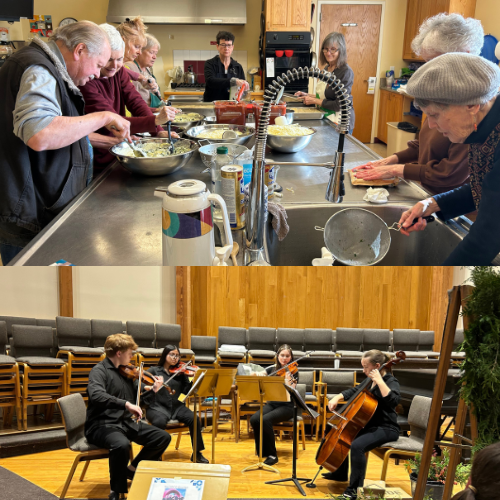
The 2025 Bazaar was a success in many ways. When all the sales and expenses were tallied, the total raised at last year's Bazaar was $29,776. Of that amount, $7,419 went to the task forces and $4,200 went to the Women's Alliance. These are record breaking amounts.
Thanks goes to all the people who worked to make the Bazaar a success. Over 150 volunteer spots were filled by our membership. Many people also volunteered to make cookies, soup, persimmon pulp, and lasagna. Many others donated books, white elephants, and golden elephants.
Special thanks goes to the teen group that decorated dozens of cookies, the YA's (young adults) who planned and ran the wine/cheese event in the artisan room, and the High School string quartet who enlivened the atmosphere in the artisan room.
We can all be proud of our efforts that led to reaching our three goals of raising money, providing opportunities for members to be involved in new ways, and putting a friendly, enthusiastic face to the public.
MUUSA Group Karaoke & Chili Fundraiser
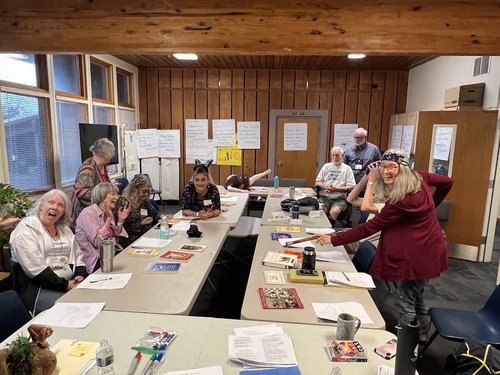
Friday, February 27 at 6 p.m.
Sing WITH your supper at a fun intergenerational night of chili, mac n' cheese, cornbread and cookies! Oh yeah, and "group karaoke!" (Think of it as a "sing-a-long but with food).
This is a donations-only event intended to raise money for scholarships to help UUCB families and teens attend UU summer camp (MUUSA) this summer. The Midwestern Unitarian Universalist Summer Assembly (MUUSA) is an intergenerational, week- long "camp" for Adults, Young Adults, Senior High School, Junior High School, Elementary, and Early Childhood campers.
MUUSA is a place for spiritual reflection, intellectual growth, and creative play within a caring and supportive community. Teens can attend camp with or without their families. Youth campers live separately from adults with their own counselors and their own programming. Much of the program is created by campers themselves. Activities include games, athletics (like ultimate frisbee, hiking, e-gaming, and ridiculous games made up on the spot.) Worship and spiritual meetings are created and organized by campers and their counselors. UUCB hopes to make MUUSA a regular extension of our religious education program.
Several UU families have attended MUUSA for years. Although we'll have plenty of information at the fundraiser, don't hesitate to ask the many UUCB members who have attended MUUSA for years, among them Jane McLeod and Steve Krahnke, Guy and Connie Loftman, Sam and Eve Cusack, and Ruellen Fessenbecker. Check out MUUSA.org for more information.
Recipe for Fellowship
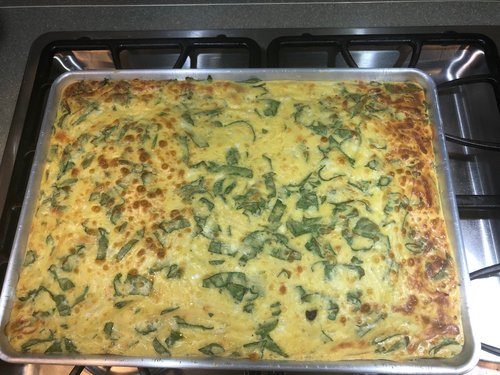
Interested in a Gluten-Free breakfast recipe? This one is based on a crustless-quiche recipe and substitutes Gluten-Free flour (I prefer King Arthur Gluten-Free Measure for Measure) for all purpose flour. You can create egg-bites with any of your basic strata or breakfast casserole recipes. Instead of double layering in a 13”x9” casserole dish, make a single layer in a 13”x18” half-sheet pan and bake for a slightly shorter time. The results can be cut into 6-12 pieces for an entrée, 12-24 pieces for a brunch dish, or 96 pieces for bites. This original recipe was for a 9” pie plate and can be found here, https://karenmangum.com/crustless-smoked-turkey-and-spinach-quiche/.
I used roughly a 2.5x conversion to a half sheet pan. Feel free to be creative!
Crustless Quiche with Mushrooms and Spinach
2 Tbs olive oil
1 Tbs butter
½ onion, chopped
12 oz mushrooms, sliced
½ cup grated cheddar cheese
8 oz grated Swiss cheese
2-2 ½ cups baby spinach, stemmed and chopped
2 ½ cups cottage cheese
1 can evaporated milk (12 oz)
10 large eggs, lightly beaten
1 ¼ cup Gluten-Free or all purpose flour
1 Tbs baking powder
Salt & pepper
- Heat butter and olive oil in a large pan. Sauté onions and mushrooms until mushrooms release their juices. Season with salt and pepper and continue cooking until juices are evaporated. Set aside to cool.
- Grease a half sheet pan and sprinkle cheddar cheese in the bottom of the pan. Spread cooled mushroom onion mixture over the cheddar cheese. Pre-heat oven to 350 degrees.
- In a large bowl combine Swiss cheese through eggs. Combine flour with baking powder in a separate bowl. Sprinkle part of flour mixture over egg mixture and stir in; repeat this until all flour is combined well. Pour egg mixture over mushrooms and spread evenly.
- Bake at 350 degrees for 25-30 minutes, until golden on the edges and set in the middle.
Upcoming Services
February 1, 2026
Calm Within The Storm: Recipes for Resilient Action
Judson Webb
Ministerial intern Judson Webb will join us to explore our relationship to truth and peace in an era where both can appear lacking.
Judson Webb is the intern minister at the UU congregation in Columbus, IN. He's in training to be an ordained UU preacher and will be at UUCCI until the spring of 2027. Judson is a Texan by birth but has lived the past 14 years in Sweden. Prior to heeding the call to ministry he worked as an actor, an acting teacher, and an applied theatre facilitator with a specific focus on peace building.
February 8, 2026
Scout's Truth: Lessons from To Kill a Mockingbird
Rev. Susan Frederick-Gray
Auction Sermon: Marcia Hart won my sermon in the auction and asked that I speak about Harper Lee’s To Kill a Mockingbird and in particular the character of Scout. What a great opportunity to reflect on truth.
February 15, 2026
In Search of Truth and Wisdom
Rev. Susan Frederick-Gray
Truth can denote something factual, but it can also point to the deeper meaning of things. Truth in this sense can actually draw us to confront some of life’s most difficult realities. However, it also means that the search for truth can help us grow in wisdom.
February 22, 2026
Why Truth Matters
Rev. Susan Frederick-Gray
In these days of deceit, truth matters. As do seekers and defenders of truth. Our UU tradition has a long commitment to seeking truth. Let’s explore this commitment and its importance to creating Beloved Community.
