Perspectives for April 2026
- From Rev. Susan: Interdependence
- Education Matters
- From the Music Director
- Welcoming Our New Members
- Together In Hope and Courage!
- Board of Directors
- Pathways to Engagement
- Social Justice Moment: Green Sanctuary Task Force
- Homelessness Task Force Update
- 25% Sunday Plate Fund Applications Open!
- On Interdependence: Look to the Crafters
- Upcoming Services
Table of Contents
From Rev. Susan: Interdependence
Interdependence is a core theological value of Unitarian Universalism. Interdependence describes the mutual dependence between things, between beings. It is a reminder that we as individuals are not isolated beings but indelibly interconnected with all of life. Even as we celebrate the beauty of each individual person and recognize the importance of individuality, we also recognize that all of our lives, from before we are born until we die, we need others to live, grow and thrive.
The articulation of interdependence as a core principle in our tradition happened officially in the mid-1980s. But this changing understanding emerged over time from the influence of the environmental movement and the women’s movement. It was also informed by the civil rights movement and American Indian movement. All of these justice movements were responding to social structures and even theologies built on false notions of hierarchy and supremacy. These movements informed our progressive religious tradition and helped us articulate a theology rooted not in dominion and subjugation, but one reflected in partnership and mutuality, interconnection, stewardship and care.
This theology of interdependence is crucial in this moment when progress toward equality among all people and commitment to care for the earth is being undermined and reversed. Too often particular interpretations of religion are being used to argue that supremacy and hierarchy, particularly, cis-hetero patriarchy is the natural order of things. I am off to a conference this week exploring the ways that within authoritarian movements, the subjugation and denial of rights to women and LGBTQ people is a common thread. And more importantly, how faith communities can offer narratives and theologies that counter these messages and how we can more effectively organize to both protect women and LGBTQ equality and resist authoritarianism. I am excited to share some of what I learn.
Unitarian Universalism is in a powerful position to be a part of this movement because our tradition explicitly names interdependence as a core value. Throughout the month of April, we will explore the theology of interdependence and how it is a powerful antidote to movements rooted in domination and subjection of the other (however that is defined) and the earth.
Rev. Susan Frederick Gray
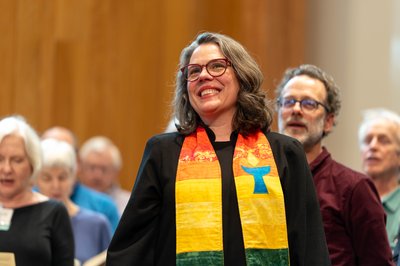
Lead Minister
revsfg@uubloomington.org
Education Matters
April’s congregational theme mirrors a fundamental understanding of the world among Indigenous peoples: we are all connected. We are connected to all beings, all of us dependent upon and responsible to each other. What would it mean to live in accordance with that truth? How would our lives change if we truly understood ourselves as beings of the natural world, neither above nor below other beings but in kinship with all? Read on for information and opportunities in lifespan religious education.
Each month, the Indigenous Studies Reading group gets together to explore questions like this and other things we are learning about Indigenous worldviews, histories, philosophies, and current events through our individual reading, interactions, film viewing, and other experiences. In a separate monthly meeting, we plan events and activities for ourselves and the congregation. Anyone who would like to participate in either (or both!) of these groups should contact me (kimball@uubloomington.org).
On April 4, all are invited to attend the IU Traditional Powwow held in Wilkinson Hall at Indiana University (17th & Fee Lane). The event is open to the public from 12 - 5pm, and people are free to come and go throughout. Read more about the event here. Anyone interested is welcome to meet in the church parking lot at 11:45 and walk together to Wilkerson (approximately 10 minutes, 0.4 miles).
Save the Date! On Saturday, June 7, we will visit IU’s Museum of Archaeology and Anthropology for a guided tour of the “City on the River” exhibit and more. Stay tuned for more details!
Resisting Tyranny, Building Power
How are you feeling about the state of the world these days? I imagine a range of responses, likely including angry, scared, sad and overwhelmed. I’m feeling these things too. But I am also feeling a great sense of potential in our collective resistance and the possibility of building a better world in the wake of the chaos and destruction we see happening now. The question is whether we will be able to build a sustainable movement that can show up in the public square but also work behind the scenes; expend the energy needed to win while also taking care of ourselves and each other; strategize for the long term while also responding appropriately to the moment.

It’s a tall order, but that’s where Deepa Iyer’s ecosystem approach to organizing comes in. In her book Social Change Now, Iyer describes ten roles essential to social change movements, and how they each support and rely on one another. This month, all are invited to meet on three Wednesday evenings to explore these roles and their interconnectedness, and identify which roles best suit our current energies, skills, and interests. We’ll be able to see where we need, as a community, to build power, skills, and relationships. We’ll be able to focus on the work that energizes us, knowing that other parts of the ecosystem are functioning in their own important ways, and together, we will be an effective, powerful, and resilient community of resistance.
Please register here and attend on April 15, 22, and 29 from 7-9pm, with dinner provided at 6pm. Participants will receive a copy of Deepa Iyer’s book.
Clothing Swap

This spring’s clothing swap will be held on Saturday, April 11, 10am - 12:30pm in Fellowship Hall. This is an opportunity for you to unload your unwanted items, but, more importantly, to “shop” for what you need instead of buying new. Clothing manufacturing is extremely detrimental to the environment, especially in these days of fast fashion. In many cases, working conditions in garment factories are horrendous. And when clothing is returned to stores, many retailers destroy it rather than repackaging it for resale. A really good way to resist and disrupt all of these harmful practices is to simply refuse to buy!
Swapping is easy. Simply bring your unwanted clothes (clean, and in wearable condition, please) on the morning of the swap. Volunteers will distribute them to the various tables, and you are free to browse to find what you can use. There is no limit on the number of items you may take, and no requirement to bring anything. We always have a LOT of leftovers, so if you’d like to help out we always welcome extra hands helping to pack up those leftovers when the swap ends and deliver them to local charities. We donate to a variety of organizations, depending on capacity, known needs, and availability of drivers.
In addition to clothing and shoes, people often bring household items, toys, costumes, and more. Please do NOT bring large items like furniture, appliances, or electronics – remember that volunteers will need to carry and transport leftover items!
Call for Proposals
Do you have an idea for an adult or multigenerational religious education program you would like to offer? The RE Development Team would love to hear it! Please fill out this form for 2026-27 programming. We will begin reviewing proposals on May 1, with a final deadline of June 1, 2026.
Call for 2026-27 Volunteers for Children & Youth Programming
Have you volunteered in children/youth religious education lately? If not, please consider joining a teaching team in 2026-27! Spending an hour with children or youth once or twice a month is a wonderful way to get to know young people, explore our congregational themes, and reflect on your own lifelong search for meaning and growth. Signing up now enables your religious education staff to develop realistic programming plans, and spend more time on development rather than volunteer recruitment. Please email me (kimball@uubloomington.org) if you are interested in volunteering in 2026-27.
From the Music Director
All-Ages Orchestra schedule:
Sat. April 4, 10-11 a.m., Meeting Room
Sun., April 5, between services, Library
Sat. April 11, 4:30-5:30 p.m., Meeting Room
Wed. April 15, 7-8 p.m., Meeting Room
Sat. April 18, 4-5 p.m., Meeting Room
Sun. April 19, 9 a.m. rehearsal, 10:30 a.m. ONE SERVICE performance!
Music is a new arrangement of the Hallelujah Chorus for string orchestra, 4-levels.
Welcoming Our New Members
With this month’s congregational theme of Community of Interdependence, it seems apt to introduce the new members of our congregation. During membership classes, book signings, and covenanting ceremonies, we often speak aloud the reality that we, as a congregation, are changed by the new members who join and participate in the life of our community. We are changed through new members’ decision-making via votes, engagement within committees, resources and time given, and through the meaningful relationships formed between these new members and the wonderful community they have joined. Our interdependence builds a UU community synergistically comprised of the generous creativity, gifts, and collective efforts of our members, longtime and new.
No doubt, whatever inspirations have called each of these new members to join will inspire further positive change as we welcome them into our community. I feel that interdependence is an action word, requiring that we engage meaningfully, because our interpersonal bonds both inspire and challenge us, thus coloring the interwoven tapestries of our lives. May we recognize the significance of these new members’ decision to enter into covenant within the congregation, welcoming them wholeheartedly and striving, together, to live guided by our core values, grounded in love, as we interdependently live out our lives.
Of the 12 who joined, six of our new members from the past two months submitted bios to be included in this issue of Perspectives. I hope you will take a look below and join me in welcoming these wonderful individuals into the congregation should you run into them on a Sunday or through any of our other vibrant activities and offerings.
Anyone interested in learning more about membership and/or general engagement in the activities of our congregation is welcome to send me an email. I am happy to correspond or set up a time to have a conversation. If you are ready to join, I invite you to register for our membership class in May. It will be good to see you there!
With gratitude,
Anabel Watson
Connections Coordinator
connect@uubloomington.org
New Member Bios:
Zach Ammerman
Zach Ammerman is a designer specializing in cartography and data visualization. An Indiana native, Zach moved back to Bloomington last year with his partner, Mark Reyes (and their ridiculous pomeranian Flora and kitty Berry), last year after spending ten years in Washington, DC, where he worked for the Embassy of France. Zach is interested in history, sustainability, language, and fell down a rabbit hole studying Daoism a few years ago out of which he is yet to climb.
Sam Franklin
Samuel (or Sam; either is fine) lives near the woods with his wife, Jenna, and cat, Big Stuff. A longtime percussionist, he enjoys drumming with the Southern Indiana Pipes and Drums, as well as developing his technique on the bodhran. He is looking forward to spring, attempting to garden, and hiking new trails.
Jaxon Incollingo
Hi. My name is Jaxon Incollingo, and I started attending UU last June. I am non binary and use he/they pronouns. I have felt more welcome here than I have anywhere else in a long time. I have been searching for a place where I can find community and spirituality, and this seems to be the right place for me. I am a single parent of three teenage kids ages 20, 17, and 15. Their names are Luke, Zach, and Chloe. I spent many years working as a paramedic, and I am now working as an ER nurse. I am interested in becoming involved in the racial justice and LGBTQ rights task forces. I am also interested in meditation, greeting, and helping any way I can medically. My hobbies are running, hiking, reading, playing guitar, and traveling (when I can afford it). I hope to get to know a lot of people and make many friends.
Jenna Kelly
I'm excited to join this congregation! I am looking forward to nurturing my skills and sharing them with the community. My husband, Sam, and I care for 1 cat named Big Stuff, and are enjoying living in our new house just off of the Scarlet Oak hiking trail. I find joy in fiber crafts, video games, cooking, and communing with nature.
Tom Pennington
My name is Tom Pennington, 71. I was born and grew up on the southside of Indianapolis.
I am single and living in the Greenwood, Center Grove area but hope to move to the Bloomington area soon. My first experience of questioning the constructs of religion was at age ten while learning about my Jewish friend's unhappiness with the required daily Bible study class at our public grade school. A fun fact about me is I want to build an Earthship class home, an Indiana version anyway.
Mark Reyes
Mark Reyes is an invasive plant specialist for the City of Bloomington Parks and Recreation Department. Mark moved to Bloomington last year for the first time with his partner, Zach Ammerman, and their dog Flora and kitty Berry. A native of Durham, North Carolina, Mark is excited to be exploring another college town and has spent the past 8 years in Washington DC. He loves reading, embroidery, and spending time outdoors.
Together In Hope and Courage!
One year ago, I experienced my first UUCB pledge drive and was surprised with the energy and enthusiasm it generated. The personal stories about giving shared during the services and the information found in the Pledge Packet helped guide my pledge decision. But most of all, I was impressed by the overwhelming SUCCESS of this appeal to the UUCB community.
Our 2026-2027 Pledge Drive, Together in Hope and Courage, began last Sunday and you should have picked up a Pledge Packet. If you did not and are a UUCB member or pledged in 2025-2026, your Pledge Packet will be mailed to you. If none of the above apply and you would like to make a pledge, just stop by the Pledge Drive table on Sunday to pick up a Pledge Packet.
This year our goal is $845,000 and includes a 5% increase to meet rising staff costs, maintain our growing Religious Education program, and add a Ministerial Intern to our staff in Fall 2026.
Why add an intern? A full-time intern working with Rev. Susan Frederick-Gray would provide additional support for worship, pastoral care, and educational and spiritual learning at UUCB for our nearly 500 members and friends. Since the beginning of February, two Sunday services have been led by interns: Judson Webb from the UU Church of Columbus, IN and Jeff LaBonde from the UU Church of Lexington, KY. If you were lucky enough to attend these services, you heard an inspiring message and may also have a better idea of what an intern could bring to UUCB. More details on this and plans for adding a second minister can be found in the Pledge Packet.
As the Pledge Drive Committee brainstormed ideas for a theme in Fall 2025, we talked about the world we are living in, how it impacts each of us daily, and how to promote positive change. From these discussions, Together in Hope and Courage developed along with example actions that we hope will resonate with you:
Together, we courageously organize for our values.
Together, we create sanctuary that provides hope for our spirits.
Together, we imagine a world that is more loving and just, where all people can thrive.
Please consider your gifts, talents, and financial resources as you decide how to respond with generosity. Then complete your Pledge Card and return it. Your financial pledge is important to the financial health of UUCB, but only one of many ways each of us can support the work of UUCB. Thank you for all that you do to support our blessed community.
Three Ways to Pledge
- Pledge Online – Click on this link Make a Pledge of Financial Support which takes you directly to the online pledge form, fill out the form, and hit the SUBMIT button (OR go to the UUCB homepage at uubloomington.org and click on the Pledge Drive link), or
- In Person – Return your completed Pledge Card to a committee member on Sunday at the Pledge Drive Information table outside of Fellowship Hall, or
- By US Mail – Mail your completed Pledge Card to UUCB at Unitarian Universalist Church of Bloomington, PO Box 8132, Bloomington, IN 47407.
Sincerely,
Don Richards
On behalf of the UUCB Pledge Drive Committee
Corrin Clarkson, Chair; JaneAnn Gifford, Renate Kasak, Charlie Pickle, Don Richards, Pat Slabach, Rev. Susan Frederick-Gray
pledgedrive@uubloomington.org
Board of Directors
Our annual pledge drive is underway! Its theme, Together in Hope and Courage, resonates with April’s monthly congregational focus on what it means to be a Community of Interdependence. We depend on each other to share our resources (financial and otherwise) to sustain and grow our beloved community. The pledge drive offers you an opportunity to contribute financially and, in that way, to support our collective effort to organize for our values, create a sanctuary that provides hope, and imagine a world that is more loving and just. We encourage you to give as generously as you can based on your financial circumstances and commitment to our community.
Being part of an interdependent community requires that we be intentional in our relationships with each other. Unitarian Universalism is a covenantal faith. Our Congregational Covenant describes how we will be together in ways that acknowledge and honor our interdependence. Because we are not perfect, we also need to develop support for times when we fail to uphold our Covenant and are no longer in right relation with each other. Last year, the Board asked a small committee (Libby Devoe, Carol McCord, Scott Russell Sanders, Rich Slabach) to review our Congregational Covenant and the charge to our Right Relations Committee, which had become less active since the pandemic. The Right Relations Committee serves as a resource as we live our Covenant and is available for guidance in times of conflict. We reestablished the Right Relations Committee this year and are now working with that committee on a revised Congregational Covenant that we hope to bring to the annual meeting for discussion and vote. We are grateful to Denise Breeden-Ost, Mary Mahern, Charlie Pickle, and Drew Schrader for agreeing to serve on the Right Relations Committee; you will hear directly from them soon!
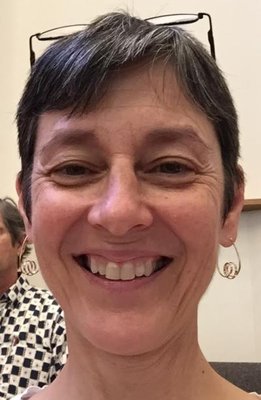
Pathways to Engagement
Pathways to Engagement at UUCB: Panel Presentation and Discussion on Saturday, April 11
Registration required, register at this link.
Ever look at active UUCB members and wonder how and when they got so involved? You might be surprised at their individual pathways to engagement in UU activities. Come listen to a panel of active members to learn more about the different ways you, too, might engage in the life of this community. Everyone started out here as a newcomer and an observer. So, come hear some unique stories so you can build your own pathway here at UUCB. There will be an opportunity for Q&A and discussion.
Who? All are welcome
When? Saturday, April 11, 10 a.m. to 11:30 a.m. (with coffee and donuts at 9:30 a.m.)
Where? The Meeting Room
Organized by members of the Leadership Cultivation Committee: Glenda Breeden, Rev. Susan Frederick-Gray, Linda Pickle, Daniel Reed, Kathleen Sideli, Anabel Watson, and Von Welch
Social Justice Moment: Green Sanctuary Task Force
Artificial intelligence (AI) has a voracious and nearly exponential appetite for water, energy, and land resources, and negatively affects public health. On top of those concerns, data center construction for AI has a disparate impact on already marginalized groups, further concentrating pollution within communities with the least amount of political and economic power to stop it. AI use is not neutral. Below, we will walk you through the various environmental impacts of AI and finally conclude with a challenge for the congregation to take a more critical look at this technology, and recommend that any frivolous uses of it be cut out of your routines as part of your ongoing efforts to reduce your impact on the environment.
Water
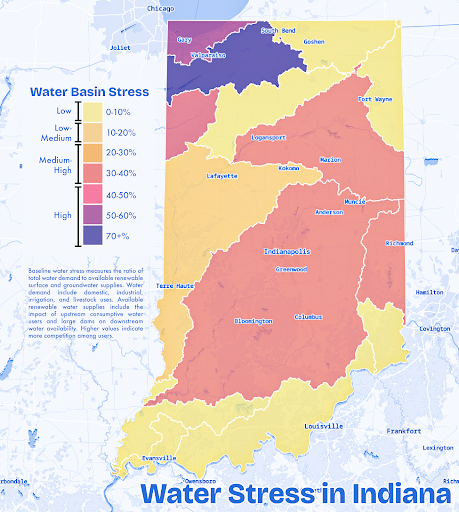
Much has been written about the unquenchable appetite of AI for water. At the global level, data centers are projected to use annually about the same amount of water as the bottled water industry. A single data center can use approximately the same amount of water in one day as a city of about 50,000 people. It’s important to note that approximately 80% of the water used for cooling data centers is “consumed,” in the sense that it evaporates or is otherwise taken out of immediate human usage, not recycled back into the local water use cycle. In other words, it to a large extent drains rather than replenishes local sources.
Withdrawal of fresh water from local streams or underground aquifers may lead to aquifer exhaustion, particularly in water-stressed areas. All of the water basins in northwestern Indiana, where a large concentration of data centers are being planned, are already using between 50 and 75% of their annual renewable surface and groundwater supply of freshwater, placing them under high stress. With all of the above in mind, it is fair to say that exponentially increasing freshwater consumption through voracious and growing use by AI data centers risks throwing our delicate planetary equation even further out of balance.
Energy
The effect of ever-increasing data center construction on energy use is particularly large. By 2030, a handful of hyperscale data centers in northern Indiana are forecast to use more electricity than the entire population of nearly 7 million residents of Indiana, according to IU’s Environmental Resilience Institute. Just ten data center proposals tracked by the Citizens Action Coalition only from the Big Four tech companies (Google, Amazon, Meta, and Microsoft) would use about four times the amount of electricity as the entire city of Indianapolis. Projections show a 90+% increase in energy use for the state of Indiana due almost entirely to the expansion of data centers by the year 2035. AI data center use could exceed all residential electricity use in the state of Indiana by 2029. Each data center also typically has millions of gallons of diesel stored on site for use as redundant backup energy, further raising concerns about groundwater pollution from diesel spills.
To meet this massive explosion in demand for energy, the state is considering expanding natural gas power plants and extending the life of extremely dirty coal-fired power plants. As AI growth explodes, data centers are increasingly relying on dirty sources of energy rather than solar, wind, or other energy sources with a smaller greenhouse gas footprint. Indiana already has some of the dirtiest sources of electricity in the country, with energy production being our top contributor of greenhouse gas emissions, making Indiana the 10th largest contributor of greenhouse gas emissions nationwide and the 9th most carbon-intensive state in the country. Adding hundreds of massive energy-hungry data centers to the mix will only make our long-term prospects for reducing greenhouse gas emissions in our state increasingly difficult, digging us further and further into a hole.
Land
In addition to the appetite of AI for water and electricity, data centers also consume vast quantities of land. A hyper-scale data center can easily use up to 1,000 acres of land. One being built now near Lebanon, Indiana, will use about 1,500 acres by the time it’s complete. Habitat loss caused by land-use change is the number one cause of our planet’s current biodiversity crisis, and Indiana is no stranger to constant, unchecked sprawl, as you can see with your own eyes when visiting the Indianapolis suburbs. AI data centers are adding fuel to the fire in Indiana’s long-term trend of allowing never-ending lateral growth and sprawl.
Public Health and Disadvantaged Communities
Big Tech companies are targeting marginalized and disadvantaged areas for data center construction, using the same model used for past and present industrial development. As a result, the environmental impacts of AI are very unevenly distributed, with higher concentrations of problems in already-disadvantaged communities. A broadly representative study on data construction in California found that data centers are disproportionately located in areas with marginalized communities that are already heavily polluted by other types of industrial development.
Looking at the impact to public health, a national study found that air pollution from data centers could contribute to an additional 600,000 asthma cases by 2028, and that public health costs associated with data center expansion could approach $20 billion per year, which would have about the same public health impact to air quality as adding 35 million pollution-emitting vehicles to the roads (roughly the same number as are in California today).
Bottom Line
For all of the statistics cited above (water, electricity, land use, and public health) the current rate of consumption for all of these finite resources is projected to only further increase with time, and the figures cited here represent an explosion from the status quo, with massive and rapid increases in resource use.
Given the above, our recommendation would be to limit the use of AI in your daily lives as much as you can, and not to use it at all for any obviously frivolous purposes. We would also challenge you to consider whether something that didn’t even exist a few years ago is something that you ever truly need to use. If you do choose to use it, you should limit it only to the tasks where it might be most effective, and you can and should favor human brainpower over outsourcing your research, creative, or analytical tasks to a machine. That brainpower is, after all, a fundamental part of what makes us human.
Additional Resources:
Interactive Map on Data Centers in Indiana: Link to an interactive map I prepared of proposed or already-constructed data centers in Indiana and their corresponding land use, super-imposed on a map of water stress in the state.
Artificial Intelligence: Whose Friend? https://www.uumfe.org/artificial-intelligence-whose-friend/
Data centers: An overview for Hoosier communities https://eri.iu.edu/resources/fact-sheets/data-centers.html
When AI Hurts the Climate, and When it Helps https://www.katharinehayhoe.com/www-katharinehayhoe-com-ai-climate-change/
By Zach Ammerman, Green Sanctuary Task Force Member
Upcoming Green Sanctuary Task Force Events!
The Green Sanctuary Task Force on Global Climate Change is excited to offer a whole host of events in celebration of Earth Month. We hope many of you will join us!
Faith in Place and the Green Sanctuary Task Force Team Up to Host a Dinner and Presentation - Tuesday, March 31 from 5:30 - 7:30 pm in Fellowship Hall
The Green Sanctuary Task Force invites you to a free communal dinner, followed by a presentation by Electrify Indiana. Madi Hirschland, Volunteer Chair of Electrify Indiana will discuss high impact climate actions you can take in your home.
As renewables increasingly out-compete fossil fuels on price, the electricity grid will go green. The question is, will we? With households accounting for 42% of U.S. carbon emissions, it’s crucial that every Hoosier household understand that when our gas-powered furnaces, water heaters and cars break down, switching to electric is smart financially and otherwise.
When: Tuesday, March 31 Doors open: 5:15 pm Dinner: 5:30 to 6:30 pm Presentation: 6:30 to 7:30 pm Where: Unitarian Universalist Church of Bloomington's Fellowship Hall (please use the courtyard entrance) RSVP: Register at bit.ly/gathering-mar31
Green Sanctuary Task Force - Clothing Swap on Saturday, April 11 from 10 am until 12:30pm in Fellowship Hall
The Green Sanctuary Task Force encourages all of us to examine our habits of consumption. What do we buy? Where does it come from? What happens to it when we're finished with it? What impact does our consumption have on the earth and its inhabitants?
Renew your wardrobe while caring for the Earth at the clothing swap in Fellowship Hall. Bring clean clothing in wearable condition on the day of the swap, and take home as many items as you can use. You are welcome, even if you don't have clothes to exchange.
Volunteers are needed to organize clothes throughout the event and at noon on Saturday to deliver any leftover clothes to local charities. Please contact Stephanie Kimball (kimball@uubloomington.org) for more information or to volunteer.
Backyard Revival, Sunday, April 12 at 10:45 am in the Courtyard
On April 12 we invite you to join us at 10:45 am for an educational session open to all. We will talk about the benefits of native plants and the problems of invasives and then spend some time removing invasives from church grounds and building some tree cages to protect new trees and shrubs which we will plant at our Earth Fair on Sunday, April 26.
Green Sanctuary Co-sponsors Concerned Scientists @ IU District 9 Candidate Forum, Tuesday, April 14 from 5:15 until 6:45 pm at the Downtown Branch of the Monroe County Public Library
With the 2026 midterm elections approaching, Concerned Scientists @ IU is pleased to announce the 2026 CSIU Candidate Forum on Science, Technology, and the Environment, which will take place on Tuesday, April 14 from 5:15 - 6:45 PM at the main auditorium at the Downtown Branch of the Monroe County Public Library.
The forum, which is one of the nation’s only candidate forums with a focus on science-related policy will feature five of the six candidates registered for the election for Indiana’s 9th Congressional District: Jim Graham (D), Brad Meyer (D), Tim Peck (D), Keil Roark (D), and Floyd Taylor (I). Incumbent Representative Erin Houchin (R) was invited, but unable to attend. The event is free and open to the public.
The forum is cosponsored by CSIU’s student affiliate organization, Advocates for Science @ IU, the League of Women Voters of Bloomington/Monroe County, Citizens' Climate Lobby of South Central Indiana, and the Green Sanctuary Task Force of the Unitarian Universalist Church of Bloomington. Note that the primary election concludes on May 5, with early voting starting on April 7.
For those unable to participate in person, the forum will also be live streamed at the ASIU YouTube channel: https://www.youtube.com/@AdvocatesforScienceatIU
For additional information, contact csatiub@gmail.com. Please share with friends, neighbors and colleagues!
Green Drinks Bloomington with Scott Russel Sanders - Wednesday, April 22 from 5:30 - 7:30 pm at the Upland Brewing Company’s Wood Shop
Green Drinks Bloomington is a lively, informal social networking event for people from all walks of life who are interested in making a greener world. We gather monthly to share libations and dialogue, explore ideas and make new friends and business connections.
Join us Wednesday, April 22 when Green Drinks Bloomington will offer a presentation by fellow congregant, Scott Russel Sanders. Scott will speak about the common wealth and its relevance for our work as conservationsists and social justice activists.
Green Sanctuary Earth Fair Tree Give Away - Sunday, April 26 after both services in Fellowship Hall
Green Sanctuary Task Force members will be in Fellowship Hall to hand out 300 trees and bushes after both services on April 26. The twelve species are described in this PDF to help you decide which one would be best for you, saving everyone time on April 26. The Backyard Revival crew invites you to join them in planting trees and shrubs on the UU grounds after the second service.
Homelessness Task Force Update
Thanks to a Social Justice Funds Grant, the UU homelessness Task Force provided pizzas every Sunday evening through February to our friends at Friends Place, an overnight shelter run by BEACON that typically houses 30 women and 10 men. Visitors to Friends Place have little access to food on Sundays, since the Community Kitchen and the Shalom Kitchen are both closed. Friends Place is always housed to capacity. A couple of our task force members visited Friends Place in February, and they saw some very happy people enjoying pizza and each other’s company. And because of the congregation’s continuing support of the homelessness task force fundraisers, we have been able to extend the pizza service until the middle of May.
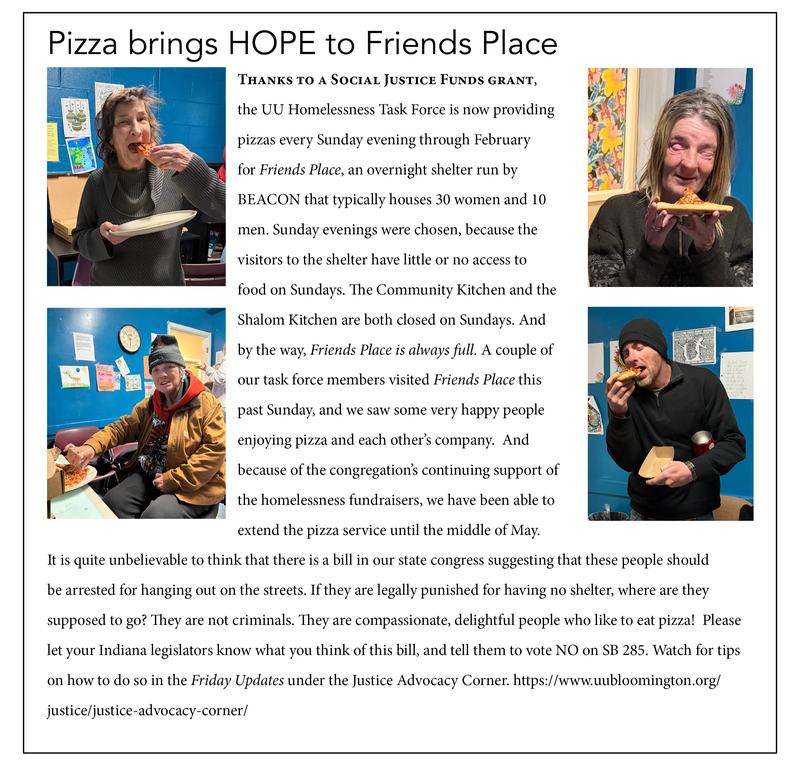
It is unbelievable to think that there was a bill in our state congress suggesting that the people we met should be arrested for camping on public property. We followed the bills closely and did what we could to defeat them with the help of the Democracy task force and with information from Shelli Yoder and Matt Pierce, and we were hoping to report that the House and Senate bills failed. Unfortunately, on March 5th Governor Braun signed the bill into law. There was an executive order given in 2025 that promoted “forced civil confinement” in an attempt to clear all encampments. This led to several states introducing bills such as ours. So now, in Indiana, a person arrested for camping or sleeping on public, state-owned land will have a Class C misdemeanor on their record, pay a fine up to $500, and could serve up to 60 days in jail. The U.S. Supreme Court ruled in 2024 that cities are allowed to enforce such laws. Our Homelessness Task Force intends to continue following related legislation dealing with housing and lack of affordable housing and work in whatever way we can to improve the situation locally to help solve the homelessness problem in a more positive way.
25% Sunday Plate Fund Applications Open!
It's time to submit nominations for our next local non-profit agency to receive 25% of Sunday non-pledge plate! Applications are available here. The application deadline is April 30th, after which the Social Justice Funds Committee will choose three finalists for the congregation to vote on at the spring congregational meeting.
Our contributions to the current recipient (Tandem) are at $4966.36 with 2 more quarters to go. The total donated to last year’s recipient Habitat for Humanity was $7120.87. Which local non-profit agency would you like to see be our next recipient?
Those who submit applications must be able to meet the following obligations: (1) contact the agency you support to gather the information necessary to complete the application. If you are among the three finalists chosen you will need to (2) provide a 200 word written information on the agency to be published in the June Perspective or Friday Update; (3) arrange for written materials to be available at the church throughout May, and (4) give a brief 3-minute presentation during the service on the Sunday of the June congregational meeting, including an overview of the organization and an explanation of how the funds will be spent. The agency will also need to be able to table in Fellowship Hall after the service May 31th and June 7th.
Contact Sarah Kopper, SJFC Chair, at uucbsjfunds@uubloomington.org with any questions.
The Social Justice Funds Committee: Sarah Kopper, Steve Mascari, Scott Sanders, MJ Wallaker, Paul Banister; Advisor: Jackie Hall
On Interdependence: Look to the Crafters
We honor the interdependent web of all existence. With reverence for the great web of life and with humility, we acknowledge our place in it.
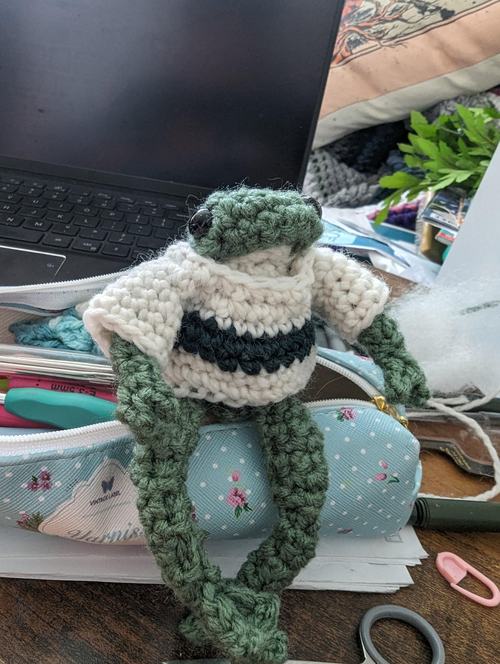
When thinking of interdependence, I look to our crafters: Those wise and skilled enough in a craft to make the sum of parts into something they couldn’t be on their own; into something wholly new and beautiful. The spinners who craft raw fibers into fine thread or beautiful yarn. The weavers who combine threads into beautiful fabric. The embroiderers who sew together new stories. The knitters and crocheters who weave yarns together into that which warms our bodies and souls. The quilters who create a colorful mosaic from threads and fabrics.
Each of these crafts is made up of innumerable threads, woven fine to create the beautiful patterns that make up the picture of our community. This must be why telling a story is called “spinning a yarn,” for much like a quilt or sweater is made from thread and yarn, which are, in turn, the sum of individual fibers, it is the experiences we have that create the stories we tell that make up our culture and our community.
In any fiber craft, should one thread fail, there are more that reinforce the integrity of the work until the piece can be mended. But left for too long, the piece will begin to fall apart - and not even the most skilled of fiber artists will be able to mend the piece back to its original state.
When I walk the halls of our beloved building, the countless threads that make up the quilts hanging on the walls remind me how we are all interconnected and interdependent.
Over the past year attending UU, I have witnessed runs in our fabric, yarn unravel, and threads fray. I, myself, at times, have felt unmendable. Each time, I have seen the fabric of this community gather and get to mending. I am not in the original state I entered this community in, but down to the fibers from which I have been made, I have been mended into something better. This community has provided me with the tools I needed to trim the frayed threads that no longer serve me and embroider new patterns into my story. I have been transformed from a worn-out piece of cloth into a panel of the beautiful mosaic that is our community.
This is why, in times like these, I look to the crafters. The ones who understand how deeply interwoven we are with the people and planet around us. Those who welcome the worn-out rags seeking their place in something bigger and more beautiful than who they are on their own. This month, as we explore our shared value of interdependence, I hope you think of the crafters, too.

By MJ Wallaker, Fiber Arts Group Organizer
The Fiber Arts Group Meets:
1st and 3rd Saturday of each month
2 p.m. in Room 112
Upcoming Services
Sunday, April 5
Easter Sunday: The Radical Jesus
Rev. Susan Frederick-Gray
On this Easter Sunday, let’s celebrate the radical teachings of Jesus. Much has been misunderstood about Jesus’s teaching. Let explore this and how his teachings – understood in a first century context - resonate and matter today.
Sunday, April 12
A Theology of Interdependence
Rev. Susan Frederick-Gray
How does having interdependence as a core religious value shape our theology and world view and why is this so essential today?
Sunday, April 19 - One service at 10:30 a.m.
Celebration Sunday! We Belong Together!
Rev. Susan Frederick-Gray
We wrap up our annual Pledge Drive campaign with a celebration of our shared community and the hope, courage and belonging this community inspires. Special music from the All-Ages Orchestra.
Sunday, April 26
All Ages Earth Day Service
Dr. Stephanie Kimball and the Green Sanctuary Task Force
Through story, song, and action we will celebrate the Earth and our own responsibilities to care for our planet home. Special music with the Family Choir.
